|
|
TRANSPORTS
VERNEY
Including
a selection of the operating companies timetables - mostly from 1969 or
earlier
Y
compris une
sélection des horaires des sociétés exploitantes - la plupart de 1969
ou plus tôt |
 |
|
From 1891
to 2002 the Verney group was a significant contributor to public
transport across France
De 1891 à
2002 le groupe Verney fut un acteur majeur des transports en commun à
travers la France |
Nota
- Il s'agit d'un site d'archives historiques et ne contient pas
les données actuelles
NB - This is a site of
historical record and does not contain current
service information
|
|
|
|
|
The Transports Verney /
Tourisme
Verney
group had its
headquarters in Le Mans, and there were a dozen or more operating
subsidiaries, mainly in the west of France.
The origins of
the
group lay with country tramways. In 1885 the Beldant-Baert
company were responsible for lines in Sarthe with further concessions
obtained in other départements over the ensuing years. Other
lines
were developed by the Verney-Dequaindry company. Overall there
was a network of some 2,000 kilometres of
'chemins de fer départementaux et locaux'. The Verney group counts 1891
as their founding year.
SCF - Société Centrale de Chemins de Fers
et
d'Entreprises
After the First War the
country tramways were becoming
progressively
outdated, and after half a century their operation was increasingly
uneconomic. Motor bus services were developed and offered
competition. After marriage Louis Verney (1872-1945) became
Francois Baert's
son-in-law, subsequently
his business partner, and eventually his successor. Progressively the
two previously named companies started to work together and on the
suggestion of Louis Verney eventually merged to form SCF in 1927; thus bringing
together the business interests of Messieurs
Baert and Verney.
The merger brought together operating concessions
for
réseaux secondaires in different départments,
some of
which dated from the last years of the 19th century.
Public transport in country areas by these secondary railways and
tramways was reasonably comprehensive but slow, and when improved motor
buses came on the scene the time was ripe to take advantage of this
viable rubber-tyred alternative means of transport.
STAO - Société des Transports Automobiles
de l'Ouest
Thus
SCF formed their
first bus company in 1933, STAO
with a
network of routes based on Le Mans (Réseau du Sarthe). Co-ordination of
road and rail transport was under active consideration by the
governmnet of the day at this time. The year 1933
also saw the death of Francois Baert, one of the co-founders of the
SCF.
The STAO had originally nine routes, several
crossing into other
departments, extending to Angers in Maine-et-Loire, Alencon in Orne,
Tours in Indre-et-Loire and Laval in Mayenne. Departments
that would soon develop their own STAO bus networks. Also three routes
based
on Alencon (in the
department of Orne) started at the same time, two towards Mamers and
one to Le Mans.
STAO was the flagship of
the group and expanded during the
1930s and 1940s to form other
networks
(réseaux) in Orne, Poitou, Touraine, Mayenne (in part by acquisition of
Les
Courriers de la Mayenne of Laval, with that trading name retained until
the late 1960s before being renamed STAO) and Seine
Inférieure / Eure. For many years the headquarters of the Verney
group were based in the rue Paul Beldant at Le Mans, remembering the
name of one of the
founders.
Other companies within
the
Verney group were STN
-
Société des Transports de Normandie in the
département of Manche, previously Chemins de Fer Normands;
Compagnie Ardennaise de Transports, centred on Charleville near the
Belgian border; STABE - Société des Transports
Automobiles de la Région de Belfort et
Environs, near the
Swiss border; CAT - Compagnie Armoricaine de
Transports, based on Saint Brieuc in Côtes-du-Nord
département (a long established company with origins dating back to the
secondary rail lines from 1891, joining the Verney group in 1962); CTF
- Compagnie des Transports du
Finistère,
operating from Brest in Bretagne, and subsequently merged with the
adjoining CAT company by 1969; Compagnie des Transports du
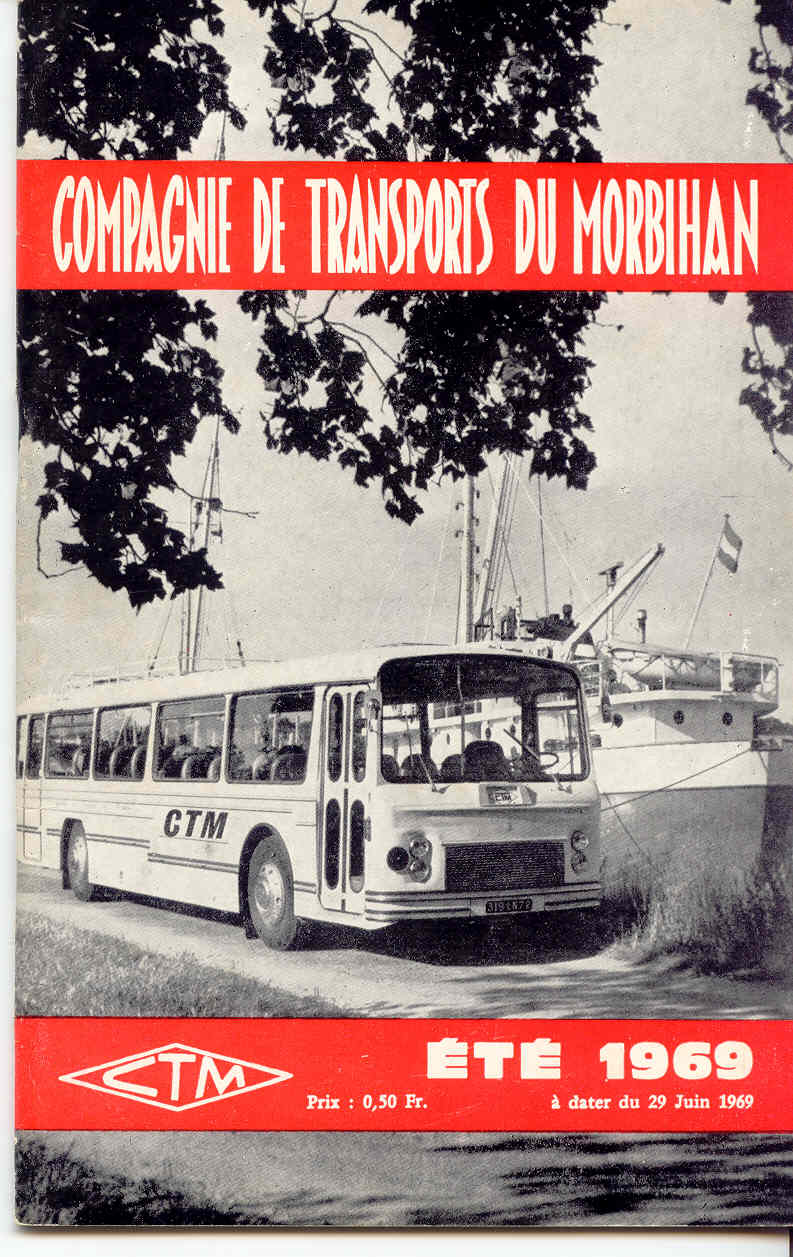
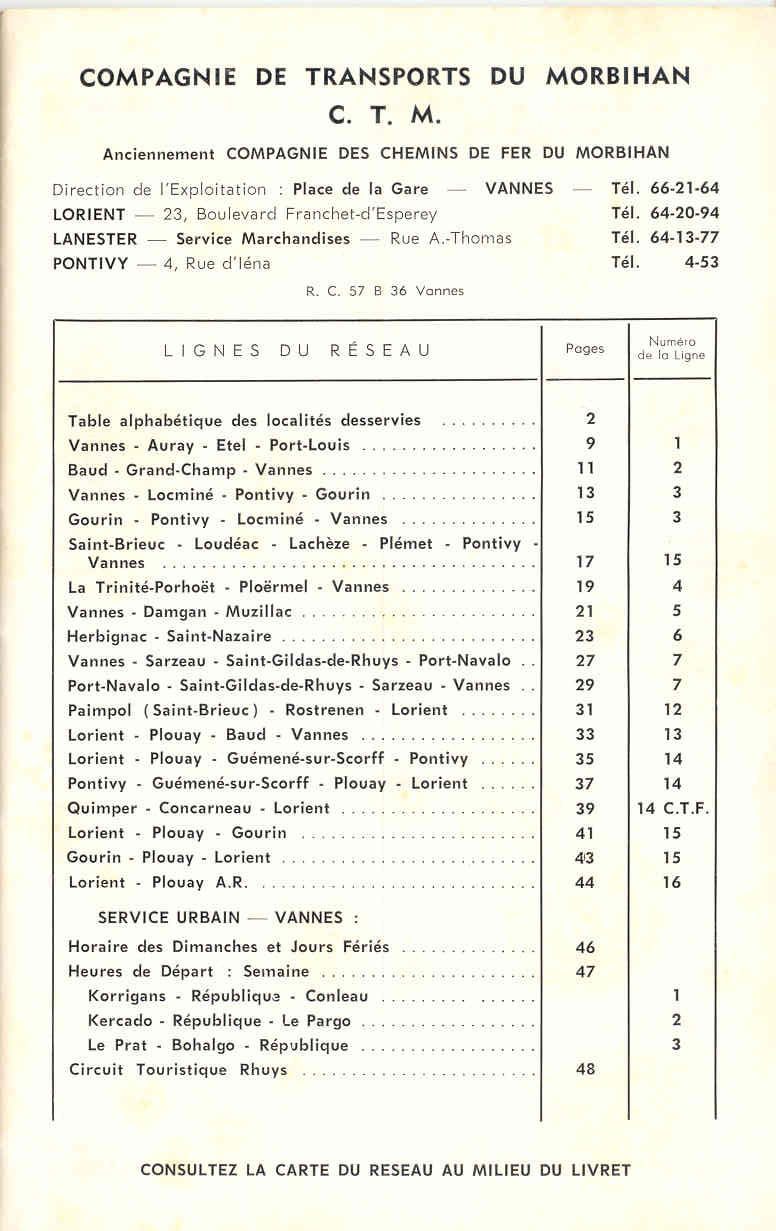
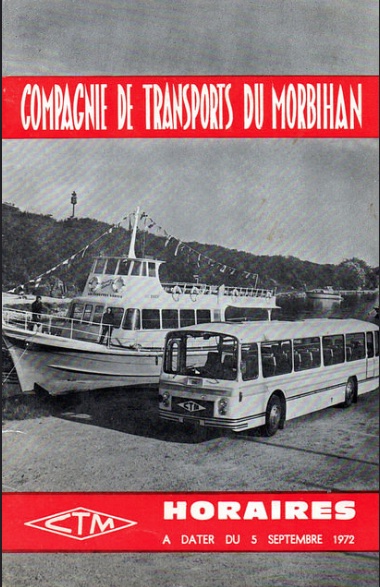
Morbihan, based in
Vannes, starting with local rail lines in 1892 as the Compagnie des
Chemins de Fer du Morbihan, in which the Verney group was always
associated until they took a majority share in the company in 1968 and
renamed it 'Transports' in succession to the previous 'Chemins de Fer';
TIV - Compagnie de Transports d'Ille-et-Vilaine, based in
Rennes and acquired in 1965.
The various timetables,
route lists and maps set out below
serve to recall the
operations of the ten Verney companies in the west of France as they
were in
1969.
There
were also Verney operations in other parts of France, notably in
Belfort
( STABE - Société des Transports Automobiles de
Belfort et Environs) and
at Charleville on the Belgian border ( Compagnie
Ardennaise de
Transports).
The Verney group
manufactured many of the buses
and autorails used on their bus routes and rail lines, autorails being
built from 1922 and buses from 1934. Under the direction of
Francois Verney bodies were built on Panhard, Renault and Citroen
chassis; these were followed by a rear-engined Citroen which took to
the road in May 1940.
In 1956
the
manufacturing activities were renamed Société des
Automobiles et Matériels
Verney, then formed into a separate company CBM Car et Bus le Mans from
1977. CBM ceased all bus production in 1986 having strayed
from
their traditional rural and interurban bus market into the building of
urban buses, a competitive market in which it was difficult to persuade
established operators to change to a new supplier. Their legacy was
the model 220B which was continued by Renault as the R212, and
then later from 1989 by Heuliez as their model GX77H. Now a
parts
supplier, CBM restyled itself as Car et Bus Maintenance.
CFIT -
Compagnie Française et Industrielle de Transports
By the year 1977 the
then six Verney operating subsidiaries were running some nineteen
hundred
vehicles between them. In April of the same year the Verney group
became
associated with the Michelin group when Transports
Citroen was taken over by CFIT.
At the time CFIT was jointly owned by the Michelin company and
the Verney group
(SCF). Yves-Michel Verney became President and Director-General. The
Citroën networks were co-ordinated and integrated with those
of Verney, which latter group found the Nantes network (which was
retitled Compagnie des
Transports de l'Atlantique) and the Angers network (which was retitled
as Compagnie des Autocars
d'Anjou) useful additions to its own existing substantial operations
across the
west of France, neatly filling gaps in the interurban network.
Tourisme Verney - following
the acquisition of Transports Citroën the Verney travel agencies were
grouped with CITER offering an integrated network of thirty six
agencies as Nord-Sud Voyages, following the transfer of the CITER
operating license. Coach tour programmes were developed by Tourisme
Verney. All tours were arranged from a provincial town or region where
the group had a coaching infrastructure. The agencies were therefore be
used to sell these programs with a widening range of starting points.
CITER / Nord-Sud Voyages took a dominant position in the tourism
business: incentive travel, study, business travel and public
relations, conferences, seminars and technical visits. In January 1990,
the North-South name disappeared with all agencies hence under one
banner: Verney.
Between
1978 and 1983, the Verney Group was in a difficult period with a
restructuring policy leading to the closure or abandonment of lines of
the interurban networks: Clermont Ferrand, Mulhouse, Lille,
Saone-et-Loire. Numbers of staff fell from 2832 to 2248 and number of
vehicles in the fleet from 1870 to 1609.
In
Sarthe, 1983 saw the first agreement
signed by STAO with the département for the operation of a
departmental network of bus routes. The fleet comprised
1548 vehicles in 1998. Calmer times returned between 1984 and
1990 when the group managed to stabilise its operations by starting to
recover with major investments such as in the acquisition of 1200
vehicles (860 new) in six years.
Verney Encore
Then in 1990 the group
somewhat unexpectedly regained its
independence
and came again under the control of the Verney
family, led by Yves-Michel Verney (grandson of Louis Verney);
retaining the many routes of
the former Transports Citroen
(founded in 1931 by the manufacturer partly as a
means of establishing a market for their own buses).
Verney celebrated its 100th
anniversary in 1991. As of January 1991, a regional and legal
restructuring with a consolidation of subsidiaries leading to new
network entities such as the CAA, CTA and CTE from Citroën. Moreover,
we note that "vintage 1990" is a revival with external growth whereby
the group acquires four companies (two in Brest and Clermont Ferrand,
two others in Lyon and Strasbourg more important). They are included in
the new regional structures. Lyon operations developed into Transports
Verney Rhône Alpes - TVRA. There were 26 corporate buybacks between
September 1990 and October
1998, which allowed the Group to maintain its independence while
maintaining growth.
Creation of a new
Verney-Ville operation allowed the group a place in the urban
environment by differentiating the different types of passenger
transport. In 1991, Verney had a presence at: Vannes, Fougères, Saumur,
Saint-Lô, Sablé, Riom and Thiers. This does not exceed twenty-two
vehicles per depot. Yves-Michel Verney insisted on an urban identity to
gain recogniton for the group in this milieu where it was not well
known.
On 1 July 1991, S.C.F.
became G.T.V. (Compagnie Générale des Transports Verney): it was the
new
principal holding company of the Verney Group. G.T.V. It was the
largest
private family group in France with an energetic pursuit of business by
the Verney family. Between 1991 and 1998 more than a dozen other
operators were acquired around the country, including Rapides de Touraine in September 1994.
Turnover evolved well between 1993 and 1997 but
with stagnation over the last two years. For the Tourism division a
drop in 1993 and 1994 followed by a definite stagnation.
Yves-Michel died in 1998
aged 63, a man of forthright and sometines controversial opinions. His
son Bruno
took the reins until February 2002, when Verney was acquired by
the Connex
group. This involved 2700 buses
and
coaches and 3300 staff, with operations principally in the Pays de la
Loire, Bretagne and Normandie but also in Rhône-Alpes, the
Paris region and Alsace. Connex is now known as Veolia.
(Compagnie Générale
d'Entreprises
Automobiles - CGEA - was founded in 1912 and became Connex in 1999. It
bought the Verney Group in 2002, and in November 2005 Connex changed
its name to Veolia
Transport).
|
|
Transports
Verney /
Tourisme Verney avait son siège social au Mans, et il y avait une
dizaine de filiales en exploitation, principalement dans l'ouest de la
France.
Les origines du groupe étaient les tramways locales. En
1885,
la société Beldant-Baert était responsable pour lignes dans la
Sarthe, avec des nouvelles concessions obtenues dans des autres
départements au cours des années suivantes. D'autres lignes ont été
développés par la société
Verney-Dequaindry. Dans l'ensemble il y avait un réseau de 2.000
kilomètres de chemins de fer départementaux et locaux. Le groupe Verney
compte 1891 leur année de fondation.
SCF - Société Centrale
de Chemins et Fers et d'Entreprises
Après
la Première Guerre les tramways ruraux devenaient progressivement
obsolètes, et après un demi-siècle leur fonctionnement étaient de plus
en plus moins rentable. Des services des autocars ont été développés en
concurrence. Après son mariage Louis Verney (1872-1945) est devenu le
fils-frère
François Baert, par la suite son partenaire d'affaires, et finalement
son successeur. Progressivement les deux sociétés précédemment nommés
ont commencé à
travailler ensemble et sur la suggestion de Louis Verney ont finalement
fusionné pour former la SCF en
1927; réunissant ainsi les intérêts commerciaux de MM
Baert et Verney. Il a réuni les concessions d'exploitation des réseaux
secondaires dans différents départements, dont certains datent des
années dernières du 19ème siècle. Les transports publics dans la
campagne par ces chemins de fer et tramways secondaires était
raisonnablement complet mais lent, et quand les autocars améliorés
arrivent sur la scène le temps était venu de prendre avantage de cette
alternative et viable transport à pneus.
STAO - Société des
Transports Automobiles de l'Ouest
Ainsi la SCF ont formé leur première
compagnie des autocars en 1933, la STAO
avec un réseau de lignes au départ du Mans
(Réseau du Sarthe). La coordination des transports routiers et
ferroviaires était en cours d'examen par le gouvernement du jour en ce
moment. C'est en 1933 que François
Baert est décedé,
un des co-fondateurs de la SCF. La STAO avait
initialement neuf lignes,
plusieurs
traversant dans d'autres départements, s'étendant à Angers dans le
Maine-et-Loire, Alençon dans l'Orne, Tours en Indre-et-Loire et à Laval
en Mayenne. Les départements
qui developpaient bientôt leurs propres réseaux de cars STAO. Aussi
trois
itinéraires basés sur Alençon (dans le département de l'Orne) a
commencé au même moment, deux vers Mamers et un au Mans.
Ce réseau était
le fleuron du groupe Verney. STAO s'agrandit au cours des années
1930 et 1940 pour former d'autres réseaux dans l'Orne, le Poitou, la
Touraine, la Mayenne (par l'acquisition des Courriers de la Mayenne de
Laval, avec ce nom commercial retenu jusqu'au les années 1960
avant d'être rebaptisé STAO) et aussi la Seine Inférieure / Eure.
Pendant
de nombreuses années le siège du groupe Verney étaient dans la rue Paul
Beldant au Mans, rappelant le nom d'un des fondateurs.
D'autres
sociétés au sein du groupe Verney étaient la STN
- Société des Transports de Normandie dans le département de la Manche,
auparavant Chemins de Fer Normands; Compagnie Ardennaise de
Transports, centrée sur Charleville près de la frontière belge; STABE -
Société des Transports Automobiles de la Région de Belfort et Environs,
près de la frontière suisse; CAT - Compagnie Armoricaine de Transports,
basé sur Saint Brieuc dans les Côtes-du-Nord (une entreprise établie de
longue date dont les origines remontent aux lignes ferroviaires
secondaires à partir de 1891, et rejoint le groupe Verney en 1962);
CTF - la Compagnie des Transports du Finistère, centre d'exploitation
Brest en Bretagne, et par la suite fusionné avec la société CAT avant
1969; la Compagnie des Transports du Morbihan, basé à Vannes et a
commencé
par les lignes ferroviaires locales en 1892 comme la Compagnie des
Chemins de Fer de du Morbihan, dans laquelle le groupe Verney a
toujours été associée jusqu'à ce qu'ils ont pris une part majoritaire
en 1968 et l'a rebaptisée "Transports" en succession à
la "Chemins de Fer" précédente; TIV - Compagnie de Transports
d'Ille-et-Vilaine, établie à Rennes et acquise en 1965.
Les livrets-horaires diverses, les répertoires
des lignes et les cartes
ci-dessous servent à rappeler les opérations des dix entreprises Verney
dans l'ouest de la France comme ils étaient en 1969.
Il existe également des opérations Verney dans d'autres régions de
France, notamment à Belfort (STABE - Société
des Transports Automobiles de Belfort et Environs) et à
Charleville à la frontière belge (Compagnie
Ardennaise de Transports).
Le groupe Verney fabriquait de nombreux
cars et autorails utilisés sur
leurs circuits d'autocars et lignes ferroviaires. Autorails
construits à partir de 1922 et les autocars à partir de 1934. Sous la
direction de François Verney les carrosseries ont été construits sur châssis Panhard,
Renault et Citroën; ils ont été suivis par une Citroën
à moteur arrière, qui a pris la route en mai 1940.
En 1956, les
activités de fabrication ont été renommés Société des Automobiles et
Matériels Verney, ensuite formée en une société séparée CBM Car et Bus
le Mans à partir de 1977. CBM a cessé toute production d'autobus en
1986 ayant dévié de leur marché traditionnel de l'autocar interurbain
et rural dans la construction d'autobus urbains, un marché
concurrentiel dans lequel il a été difficile de convaincre les
opérateurs établis à changer de fournisseur. Leur héritage est le
modèle 220B qui a été poursuivi par Renault comme le R212, et puis plus
tard
à partir de 1989 par Heuliez comme modèle GX77H. Maintenant un
fournisseur de pièces, CBM est redirigé vers l'entretien de voitures
et
de bus.
CFIT
- Compagnie Française et Industrielle de Transports
Dans
1977 les filiales d'exploitation
Verney, puis six, géraient
quelques cent dix-neuf véhicules entre eux. En Avril de la même année,
le groupe Verney est devenu associé au groupe Michelin lorsque Transports Citroën
a été repris par CFIT. A l'époque
CFIT était détenue
conjointement par la société
Michelin et le groupe Verney (SCF). Yves-Michel Verney est devenu
président et directeur général. Les réseaux Citroën étaient coordonnés
et intégrés à ceux de Verney, ce dernier groupe a trouvé le réseau
Nantes (qui a été rebaptisé Compagnie des Transports de l'Atlantique)
et le réseau d'Angers (qui a été rebaptisé comme la Compagnie des
Autocars d'Anjou) utiles ajouts à ses propres opérations importantes
existantes dans l'Ouest de la France, remplissant parfaitement les
lacunes dans le réseau interurbain.
Tourisme Verney - suite à l’acquisition des Transports Citroën une
série d’agences de voyages Verney se regroupent autour de CITER offrant
un réseau homogène de 36 agences: Nord-Sud Voyages, suite au transfert
de la licence CITER A 593 à son profit. Les
programmes touristiques autocars sont élaborés par Tourisme Verney.
Tous les circuits sont organisés au départ d’une ville de province ou
de région, là où le groupe dispose d’une infrastructure autocar.
CITER / Nord-Sud Voyages prend une position dominante dans le milieu du
tourisme d’affaires: voyages de stimulation, d’études, voyages
professionnels et de relation publiques, congrès, séminaires et visites
techniques. En janvier 1990, l’entité Nord-Sud disparaît regroupant
toutes les agences sous une même enseigne et une même politique commune
Verney.
Entre 1978 et 1983, le Groupe Verney se trouve dans une période
difficile avec une politique de restructuration conduisant à
la fermeture ou l’abandon de lignes des réseaux
interurbains: Clermont Ferrand, Mulhouse, Lille, Saône-et-Loire... Les
effectifs vont de 2832 à 2248 salariés
et le parc de 1870 à 1609 véhicules.
En
Sarthe, 1983 a vu le
premier accord signé par STAO avec le département pour le
fonctionnement du réseau départemental des lignes de bus. Un parc de 1548 véhicules
en 1998. L’apaisement revient entre 1984 et 1990 où le groupe parvient à
stabiliser son
exploitation en amorçant une certaine reprise au prix
d’investissements massifs comme l’acquisition de 1.200 véhicules
(dont 860 neufs) en six ans.
Verney Encore
En 1990, le
groupe a regagné son indépendance de façon quelque peu inattendue et
c'est à nouveau sous le contrôle
de la famille Verney, dirigé
par Yves-Michel Verney (petit fils de Louis Verney); et conservant les nombreuses lignes de
l'ancienne Transports
Citroen
(fondée en 1931 par le
fabricant en partie comme un moyen d'établir un marché pour leurs
autocars).
Verney
a fêté son 100e anniversaire en 1991. Dès janvier 1991, c’est une
restructuration régionale (et juridique) avec un regroupement des
filiales entraînant de nouvelles entités réseaux comme la CAA, la CTA
et la CTE issus de Citroën. De plus, on constate que le « millésime
1990 » est un renouement avec le terme de croissance externe où
le groupe acquiert quatre d’entreprises (deux à Brest et Clermont
Ferrand, deux autres à Lyon et Strasbourg plus importantes). Elles
sont incluses dans les nouvelles structures régionales actives. Côté
Lyonnais, c’est maintenant Transports Verney Rhône Alpes - TVRA. On
comptabilise 26 rachats d’entreprises entre Septembre 1990 et Octobre
1998 : ces derniers permettent un maintien de l’indépendance du Groupe
tout en maintenant une croissance.
Création de Verney-Ville pour permettre une place du groupe dans le
milieu urbain et bien différencié les différents types de transports
voyageurs. En 1991, Verney est présent à : Vannes, Fougères, Saumur,
Saint-Lô, Sablé, Riom et Thiers. L’ensemble ne dépasse pas vingt deux
véhicules par dépôt. Yves-Michel Verney insiste sur cette entité pour
affirmer sa présence dans l’urbain puisquepeu de collectivité sont au
courant de la présence du Groupe.
Le
1er juillet 1991, la S.C.F. devient G.T.V. pour Compagnie Générale
des Transports Verney : elle etait la nouvelle holding de tête du
Groupe
Verney. G.T.V. etait le plus important groupe privé et familial de
France
avec une reprise énergique de l’entreprise par la famille Verney. Entre
1991 et 1998, plus d'une douzaine d'autres opérateurs ont été acquis à
travers le pays, dont Rapides de Touraine
en septembre 1994. Le
chiffre d’affaire évolue bien entre 1993 et 1997 avec une stagnation
sur les deux dernières années. Pour le pôle Tourisme une baisse en 1993
et 1994 suivis d’une stagnation positive.
Yves-Michel est décédé en
1998 agé 63
ans, un homme aux opinions franches et parfois controversées. Son fils
Bruno a pris le relai jusqu'en Février 2002, lorsque
Verney a été acquis par le groupe Connex.
Il s'agissait de 2700 autobus
et autocars et 3300 employés, avec
opérations principalement dans les Pays de la Loire, Bretagne,
Normandie, et aussi en Rhône-Alpes, la région Parisienne, Alsace.
Aujourd'hui Connex est connu comme Veolia.
(La Compagnie Générale d'Entreprises Automobiles -
CGEA - crée en 1912
devient Connex en 1999. Par rachat elle intègre le Groupe Verney en
2002; et puis en novembre 2005 Connex est renommé Veolia
Transport).
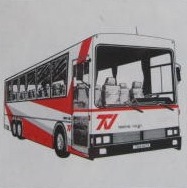
En 2013, une nouvelle organisation - ASPTV
- a été créée pour sauvegarder l'histoire, les archives et les
véhicules du groupe Verney. Malheureusement, le groupe n'existe plus et
fermera en 2025.
In 2013 a new organisation - ASPTV
- was founded to safeguard the history, archives and vehicles of the
Verney group. Sadly the group
no longer exists, closing in 2025.
|
|
|
|
The Verney operating
companies
in 1969 in Brittany, Normandy and the Loire Valley
(this section updated to reflect
the situation in 2011)
|
 |
Les sociétés filiales
Verney en
exploitation en 1969 dans les Pays de la Loire,
Bretagne et
Normandie
(NOTA - cette page mise à jour en 2011) |
|
 |
|
 |
|
|
|
 |
|
|
|
|
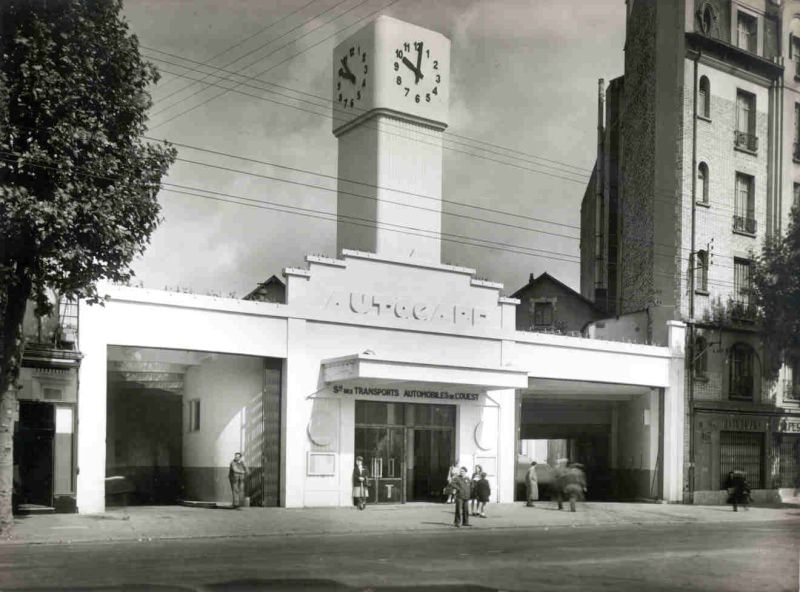
Chez la STAO: l'autogare du Mans (Sarthe)
dans l'avenue du General Leclerc, entre la gare ferroviaire et la place de
la République.
Construite en 1935 en style Art Déco pour la STAO, propriétaire
initiale de l'autogare
(la STAO était un des premiers groupes français de
transport par autocar en son temps).
Maintenant un monument historique inscrit dans la ville en 2008, pour
la façade et la toiture correspondante,
les deux couloirs d'arrivée et de départ des autocars avec leur
structure de béton à pavés de verre. Une structure
en béton armé composée d'un hall voyageurs en rotonde couverte par une
coupole en béton et pavés de verre sertis.
Elle a servi pendant plus de 70 ans jusqu'au déplacement en 2009
de la gare routière sur le pôle de la gare SNCF.
The
STAO bus station at Le Mans (Sarthe), on the avenue du General Leclerc,
between the railway station and the Place de la République.
Built in 1935 in the Art Deco style for the STAO, the initial owner of
the bus depot
(STAO was one of the first French bus groups at that time).
Now classed as a historical monument since 2008 for the facade, the
roof, and the two arrival and departure
lanes for buses with their concrete structure with glass blocks. A
building of reinforced concrete structure
consisting of a rotunda lobby for passengers covered by a dome of
concrete.
In use for over 70 years until 2009 when the bus station was moved to
near the railway station.
photo ©A.S.P.T.V.
par J.Tschill
|
|
|
|
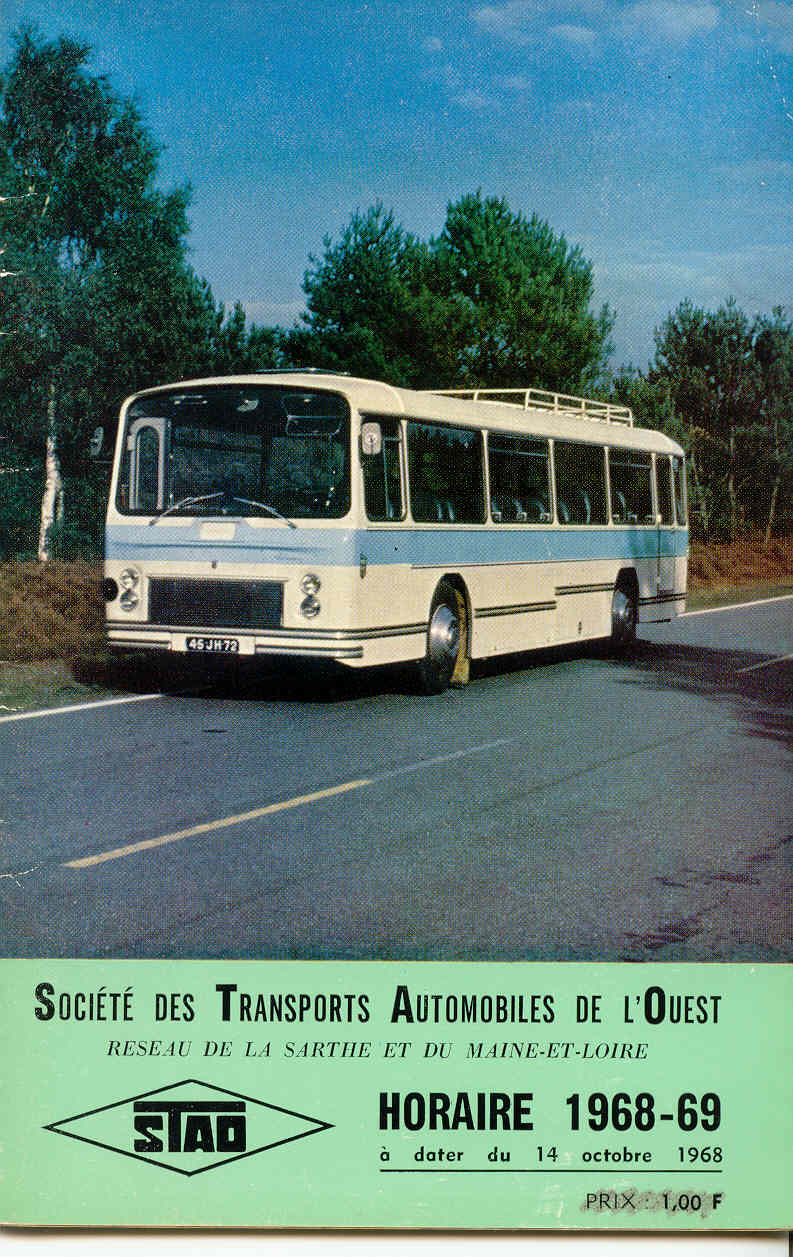
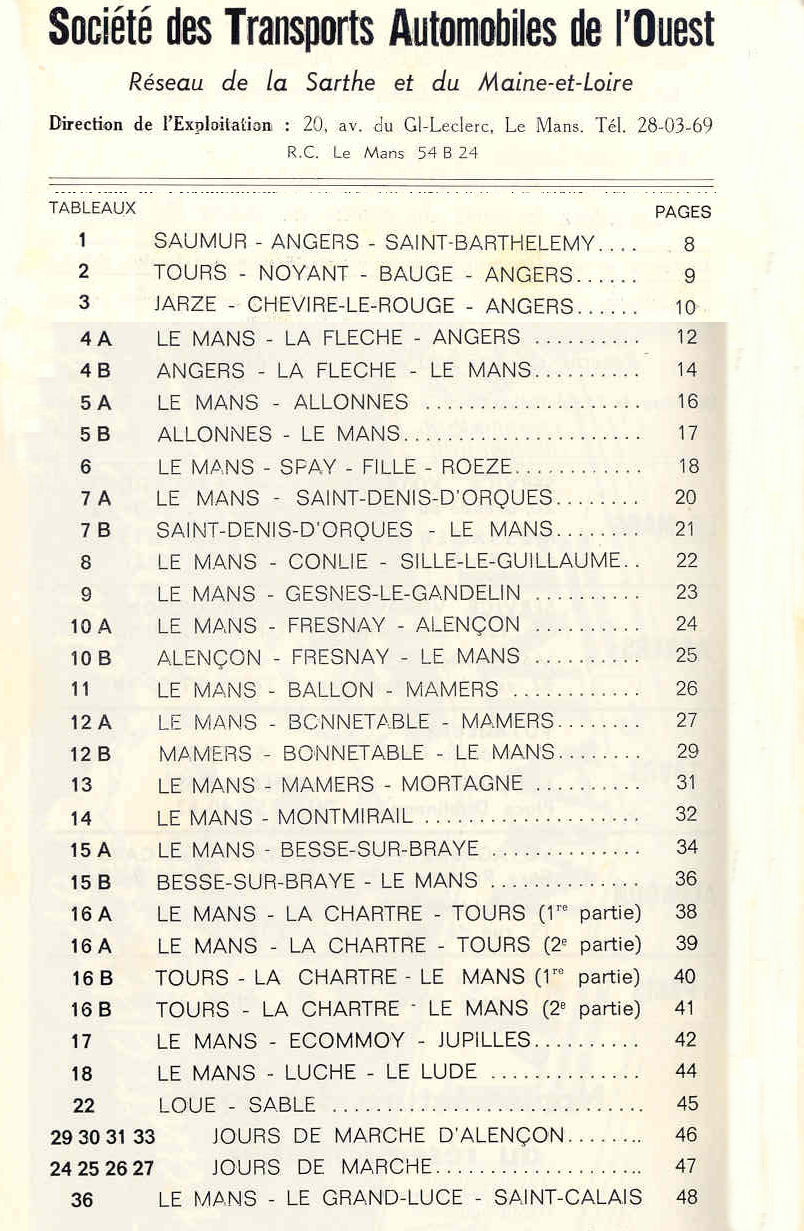
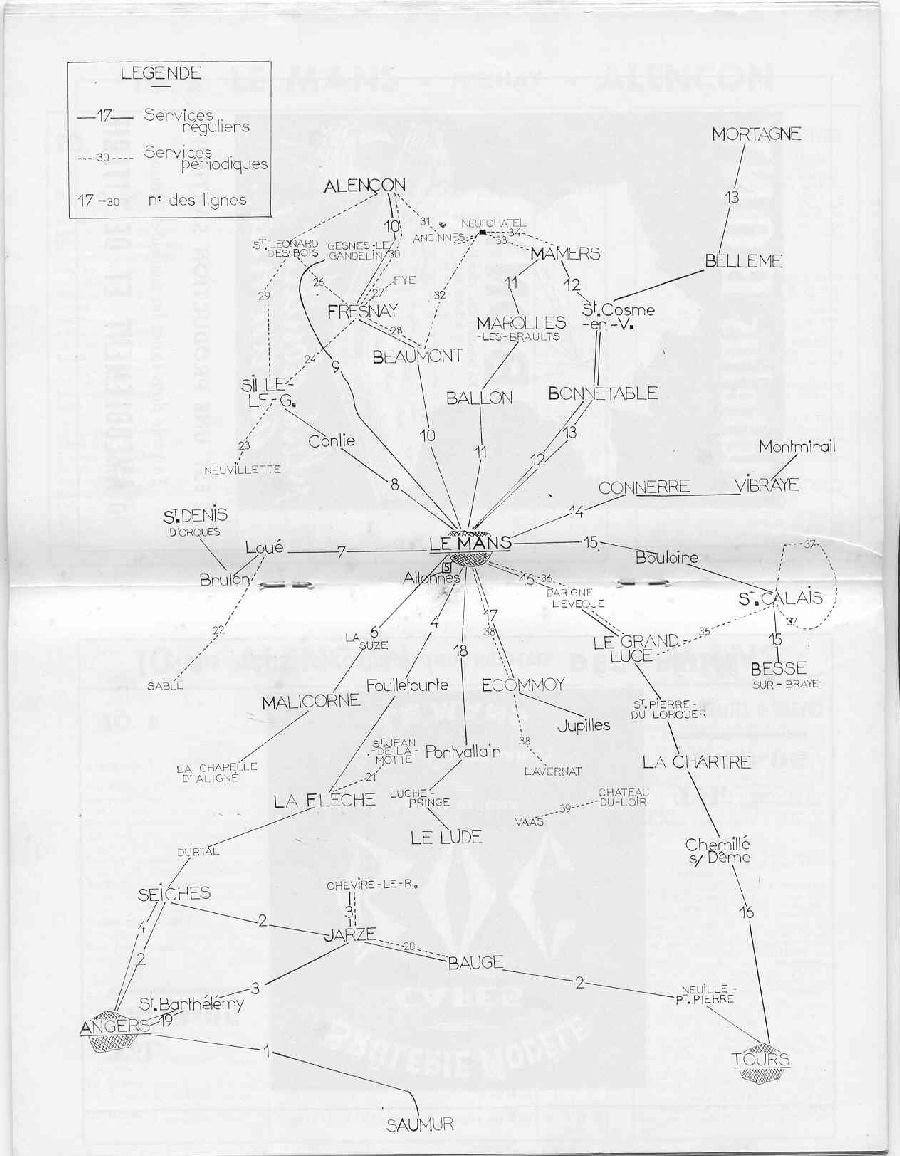
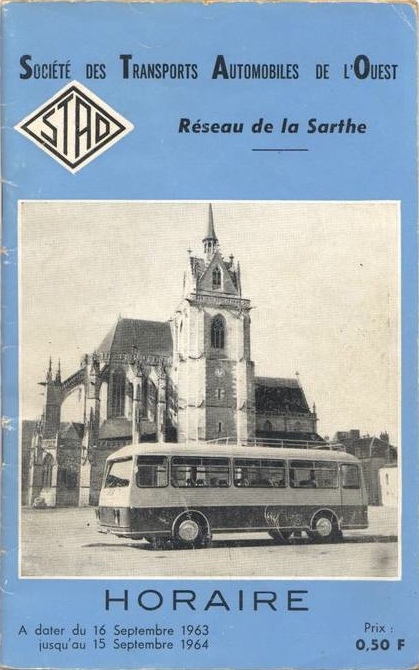
STAO timetable 1963/64 for Réseau de la Sarthe
|
In
2011 in Sarthe there is a departmental network of bus routes, supported
by the Conseil Général, called the Réseau
TIS (Transports Interurbains de la Sarthe). STAO is still a
principal provider (now a TransDev company). In Maine-et-Loire
the Anjoubus network is
based
on Angers and Cholet.
To
trace the outline history of STAO it is necessary to go back beyond
the start of bus operations. There were initially in the late 19th
century two companies competing with local rail lines in the
department: Beldant Baert and Verney Dequaindry. Gradually, the two
companies had to work closely together, eventually merging in 1927
under the leadership of Louis Verney with the birth of the SCF (Société
Centrale des Chemins de Fer). Having lasted half a century the
rail
operations were gradually
converted to road transport for economic reasons. In turn, the SCF
continued a conversion that led to their buses travelling along the
roads across Sarthe. The year 1933 saw the establishment by SCF
of STAO
(Société de Transports
Automobiles de l’Ouest) as a bus operating subsidiary of the Verney
group. There were originally nine routes, several crossing into
other departments, extending to Angers in Maine-et-Loire, Alencon in
Orne, Tours in Indre-et-Loire and Laval in Mayenne. Departments that
would develop their own STAO bus networks. Also three routes based on
Alencon (in the
department of Orne) started at the same time, two towards Mamers and
one to Le Mans. The following year 1934 the manufacture of buses
commenced in Le Mans.
Operating commercially for fifty years, STAO won a tendered operating
agreement with the department of Sarthe in 1983. Since then STAO
has continued to run on behalf of the
Sarthe department. Currently in 2012 it operates 17 lines that
serve 165 municipalities for the TIS, mainly based on Le Mans. Since
1st January 2012 the three operations in Sarthe (Le Mans STAO, Maine
Autocars Arnage and CAA Sablé sur Sarthe) were combined into one
identity: STAO 72. Veolia
subsidiary CAA (Compagnie des Autocars de l'Anjou) is the current
operator of many of the Anjoubus lines.
|
|
 |
|
|
|
 |
En
2011, dans la Sarthe, il existe un réseau départemental de lignes de
bus, soutenu par le Conseil Général, appelé le Réseau TIS (Transports Interurbains de la Sarthe).
STAO est encore un exploitant principal, maintenant filiale Trans Dev.
Dans le Maine-et-Loire le
réseau Anjoubus est basé sur Angers et Cholet.
Pour
retracer l'histoire de la STAO il est nécessaire de remonter au-delà du
début de l'exploitation des autobus. Il y avait d'abord la fin du 19ème
siècle deux sociétés concurrentes avec des lignes ferroviaires locales
dans le département: Beldant Baert et Verney Dequaindry. Peu à peu, les
deux entreprises ont dû travailler en étroite collaboration, finalement
fusionner en 1927 sous la direction de Louis Verney et la naissance de
la SCF (Société Centrale des Chemins de Fer). Ayant duré un demi-siècle
les opérations ferroviaires ont été progressivement converti en
transport routier pour des raisons économiques. À son tour, le SCF a
poursuivi une conversion qui a conduit à leur autobus voyageant le long
des routes à travers la Sarthe. L'année 1933 a vu la création de STAO
(Société de Transports Automobiles de l'Ouest) par la SCF, en tant que
filiale d'exploitation des cars du groupe Verney. Il y avait à
l'origine, neuf lignes traversant plusieurs départements dans d'autres,
s'étendant à Angers dans le Maine-et-Loire, Alençon dans l'Orne, Tours
en Indre-et-Loire et à Laval en Mayenne. Les départements qui
poursuivent le développement de leurs propres réseaux des cars STAO.
Également trois lignes au départ d'Alençon (dans le département de
l'Orne) a commencé en même temps, deux vers Mamers et un vers Le Mans.
L'année suivante, 1934, la fabrication des autobus a commencé au Mans.
D'exploitation commerciale depuis cinquante ans, la STAO a remporté un
accord d'exploitation avec le département de la Sarthe en 1983. Depuis
STAO a continué à exploiter ses lignes pour le compte du département de
la Sarthe. Actuellement en 2012, il exploite 17 lignes qui desservent
165
municipalités pour la TIS, principalement basé sur Le Mans. Depuis le
1er janvier 2012, les trois établissements
Sarthois (STAO Le Mans, Maine Autocars Arnage et CAA Sablé sur Sarthe
se sont rapprochés pour former une seule entité : STAO 72. En autre,
la filiale de Veolia CAA (Compagnie des Autocars de l'Anjou) est
l'exploitant actuel de la plupart des lignes Anjoubus. |
|
|
|
|
 |
|
 |
|
|
|
 |
|
|
|
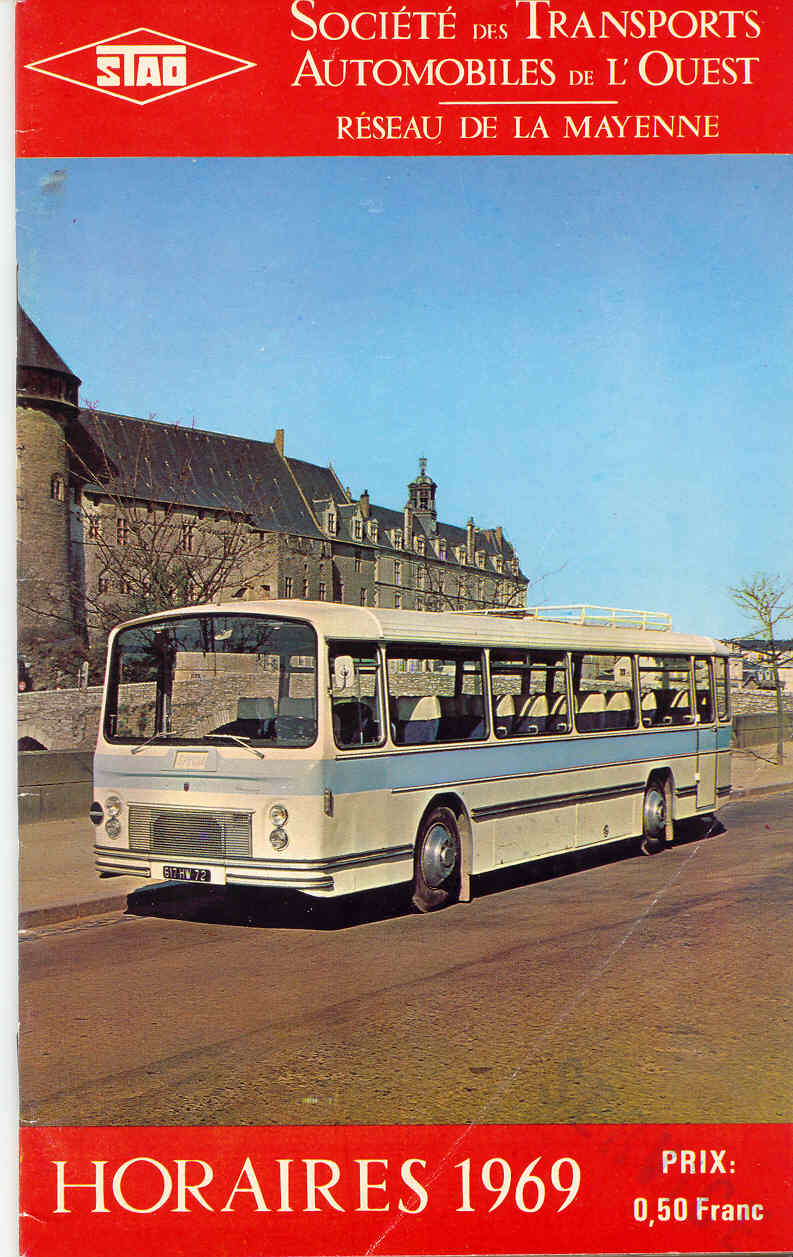
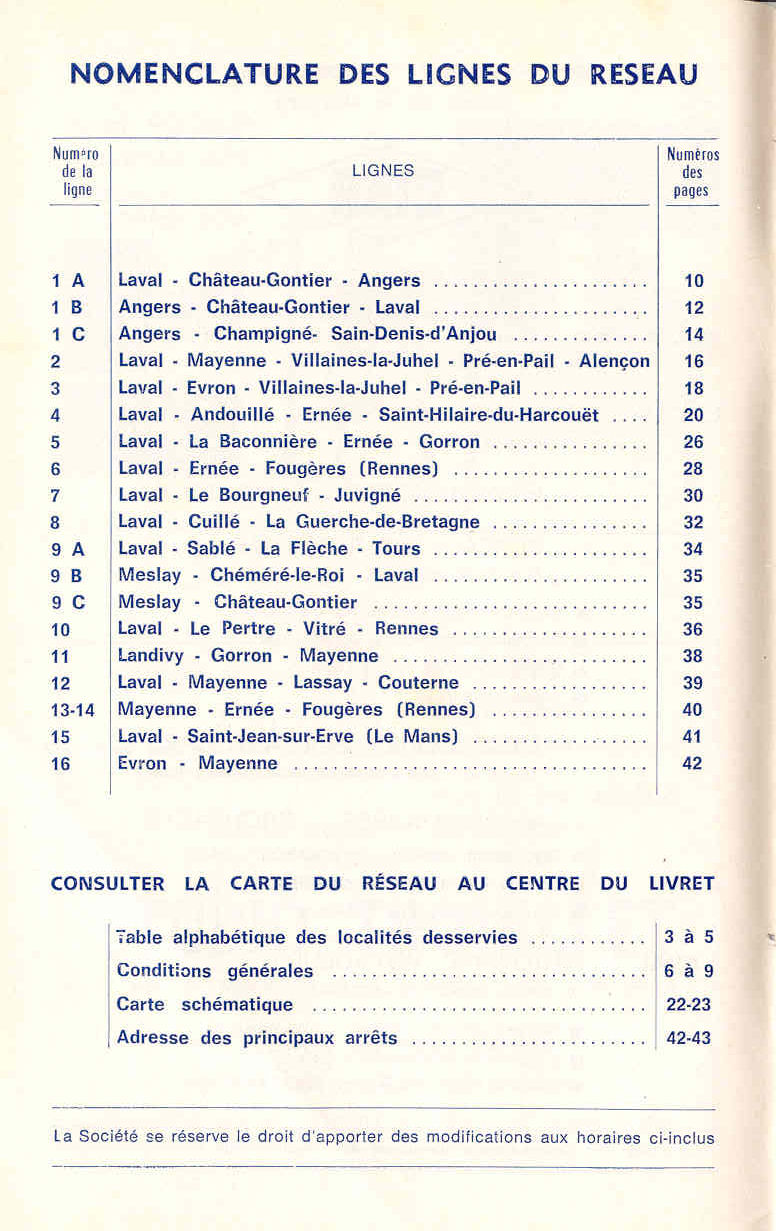
A note on STAO from May
2007 - courtesy of PA Menant:
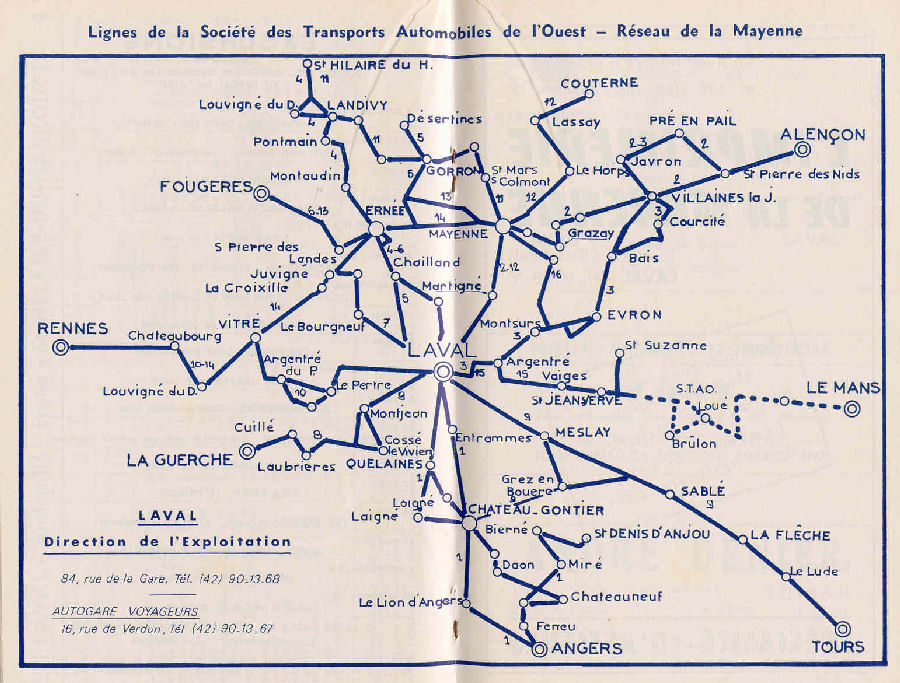
About Verney - I can confirm that today STN, STAO Mayenne, STAO Sarthe,
CTM, CAT and TIV run pretty much the same services. To be more accurate
in Mayenne STAO stills runs these lines from Laval (see the map below).
Lines 1A,
1B (both these lines are line
1A now); line 2 whose last stop is now
Pré-en-Pail (and not Alençon); line 4
whose last stop is now Ernée (and not Saint-Hilaire
du Harcouet); line 5 whose last stop is Ernée (and
not Gorron); line 7 which goes further to Saint Pierre des Landes; line
8; line 9A (now line 9) which runs from Laval to
Sablé through Meslay; lines 13 and 14 (now line 16) run from
Mayenne to Ernee and from Ernee to Landivy on demand; line 15 (now line
3) doesn't run to Le Mans anymore but to Sainte-Suzanne (two villages
further than Saint Jean sur Erve indicated on the timetable). The lines
1C, 3 and 10 have been scrapped. Line 16 was shut down and
then reopened in 2005 (but is run by another local company). Lines 11
and 12 have been modified as well and are now run by other
companies. The lines 4 and 15 replaced former local railway lines that
had been shut down just before or after the World War II. The
line 13-14 replaced a SNCF railway line shut down in 1938.
Verney was also a railcar maker and some of its railcars used to run on
the 1 meter gauge railway line from La Blanc to Argent not far away
from Tours. You can see pictures of Verney
railcars
here.
STAO Mayenne runs as well some urban services in Laval (but it
is not the main provider). In Normandy STAO still runs the
urban services in Flers but not in Alençon. In
Brittany TIV now runs urban services in Fougères.
All the coaches of STAO Sarthe run on biofuel (apart from a
few that run services on regional lines). In the
area of Tours, and in Poitou, Verney now runs much less
services.
Une note sur la STAO de
mai 2007 - avec la permission de PA Menant:
À
propos de Verney - je peux confirmer aujourd'hui STN, STAO Mayenne,
STAO Sarthe, CTM, CAT et TIV assurent à peu près les mêmes services.
Pour être plus précis dans Mayenne STAO exploite ces lignes de Laval
(voir la carte ci-dessous). Lignes 1A, 1B (ces deux lignes sont la
ligne 1A maintenant); la ligne 2 dont le dernier arrêt est maintenant
Pré-en-Pail (et non Alençon); la ligne 4 dont le dernier arrêt est
maintenant Ernée (et non Saint-Hilaire-du-Harcouet); ligne 5 dont le
dernier arrêt est Ernée (et non Gorron); la ligne 7 qui va plus loin à
Saint Pierre des Landes, ligne 8; la ligne 9A (aujourd'hui ligne 9) qui
s'étend de Laval à Sablé par Meslay, lignes 13 et 14 (maintenant ligne
16) va de Mayenne à Ernee
et d' Ernée à Landivy sur demande; la ligne 15 (maintenant la ligne 3)
ne va plus au Mans, mais à Sainte-Suzanne (deux villages plus loin que
Saint Jean sur Erve indiqué sur l'horaire). Les lignes 1C, 3 et 10 ont
été supprimés. Ligne 16 a été fermé puis rouvert en 2005 (mais est
asurré par une autre entreprise locale). Les lignes 11 et 12 ont été
modifiés ainsi et sont maintenant exploitées par d'autres sociétés. Les
lignes 4 et 15 ont remplacé les anciens chemins de fer locaux qui
avaient été fermées juste avant ou juste après la Seconde Guerre
mondiale. La ligne 13-14 a remplacé une ligne SNCF fermé ses portes en
1938. Verney etait aussi un fabriquant des autorails et certains
de ses autorails ont été
utilisés pour circuler sur la ligne ferroviaire à voie de 1 mètre de La
Blanc à Argent non loin de Tours. Vous pouvez voir des photos
de
autorails Verney ici.
STAO Mayenne assure aussi des services urbains à Laval (mais ce n'est
pas le principal exploitant). En Normandie STAO assure encore les
services urbains à Flers, mais pas dans Alençon. En Bretagne TIV assure
maintenant les services urbains à Fougères. Tous les autocars de la
STAO Sarthe fonctionnent au biocarburant (mis à part quelques-uns qui
fonctionnent sur des lignes régionales). Dans le domaine de Tours, et
dans le Poitou, Verney exploiite maintenant beaucoup moins de services.
|
|
|
|
|
In Mayenne today the departmental network is known as the Réseau Pégase.
The descendants of STAO are still operating as part of that network;
other routes are operated by Keolis.
Historically
the company, a subsidiary of Verney, started in the late
19th century but under several identities. At the time it built and
operated local railways as Chemins de Fer Départementaux de la
Mayenne. Some years later, a bus company was bought,
"Les Courriers de la Mayenne." For nearly half a century, the company
operated both passenger transport and freight carrying
activities. In 1969 Les Courriers de la Mayenne changed its name
to STAO (Société
de Transports Automobiles de l’Ouest) Réseau de la Mayenne. Eight
years later the freight business was discontinued (1977). 1981
saw a contract signed between STAO and the Conseil Général of Mayenne,
with a departmental plan of public transport put in place. In
2002 the Verney group joined Connex, which subsequently became
Veolia. Then in 2007 STAO Veolia Transport became STAO-PL Veolia
Transport
(Société de Transports Automobiles de l’Ouest - Pays de la Loire).
En
Mayenne aujourd'hui le réseau départemental est connu comme Réseau
Pégase. Les descendants de la STAO sont encore en activité dans le
cadre de ce réseau, d'autres lignes sont exploités par Keolis.
Historiquement
la société, une filiale de Verney, a commencé dans la fin du 19e
siècle, mais sous plusieurs identités. Au moment où il construit et
exploitait les chemins de fer locaux comme Chemins de Fer
Départementaux de la Mayenne. Quelques années plus tard, une compagnie
des autobus a été acheté, "Les Courriers de la Mayenne." Pendant près
d'un demi-siècle, la compagnie exploitait le transport de passagers et
de marchandises à la fois. En 1969, Les Courriers de la Mayenne a
changé son nom à la STAO (Société de Transports Automobiles de l'Ouest)
Réseau de la Mayenne. Huit ans plus tard, l'activité fret a été
abandonnée (1977). En 1981, un contrat signé entre STAO et le Conseil
Général de la Mayenne, avec un plan départemental des transports en
commun mis en place. En 2002, le groupe Verney rejoint Connex, qui est
ensuite devenu Veolia. Puis, en 2007 STAO Veolia Transport est devenu
STAO-PL Veolia Transport (Société de Transports Automobiles de l'Ouest
- Pays de la Loire).
|
|
|
|
 |
|
 |
|
|
|
 |
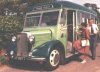
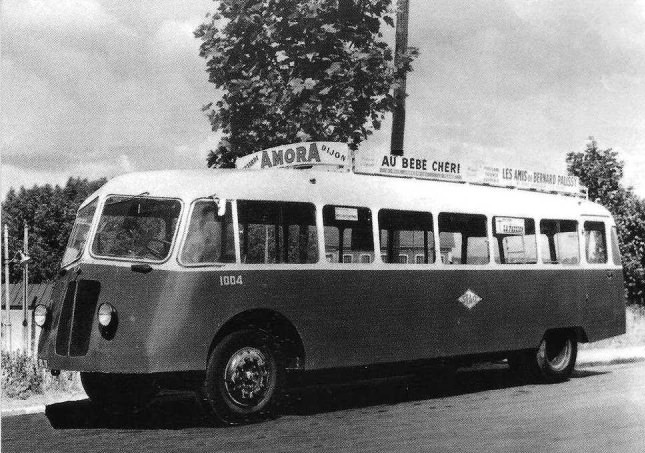
The STAO of yesteryear - a Verney LP bus
La STAO de jadis - car Verney LP
(photographer not known - photographe
inconnu)
|
 |
|
|
|
|
|
|
|
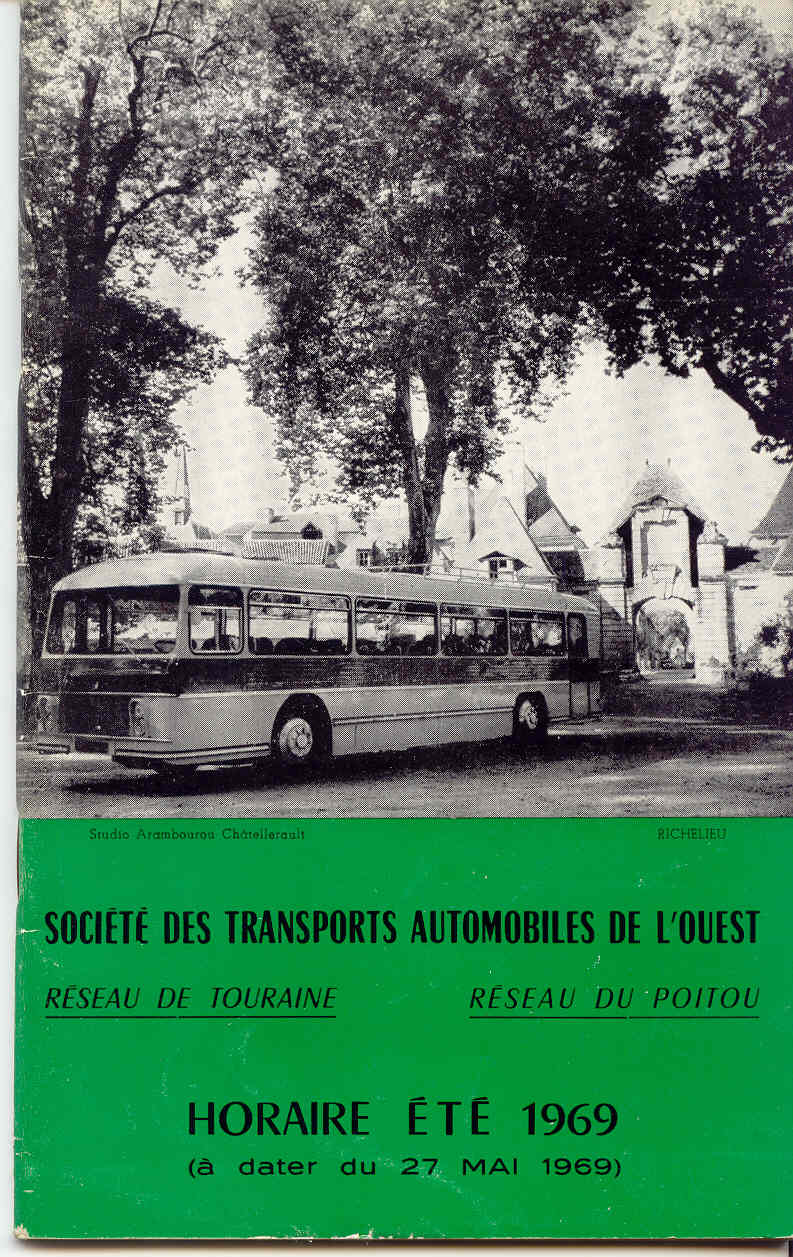
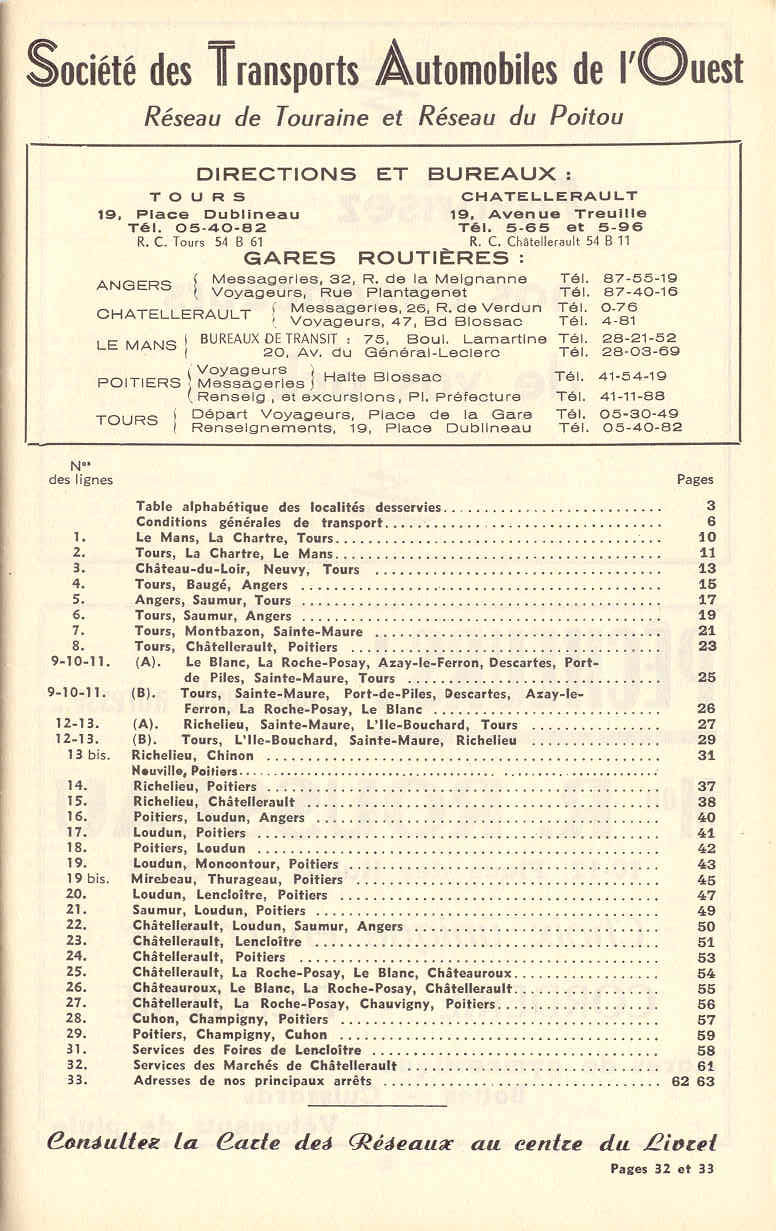
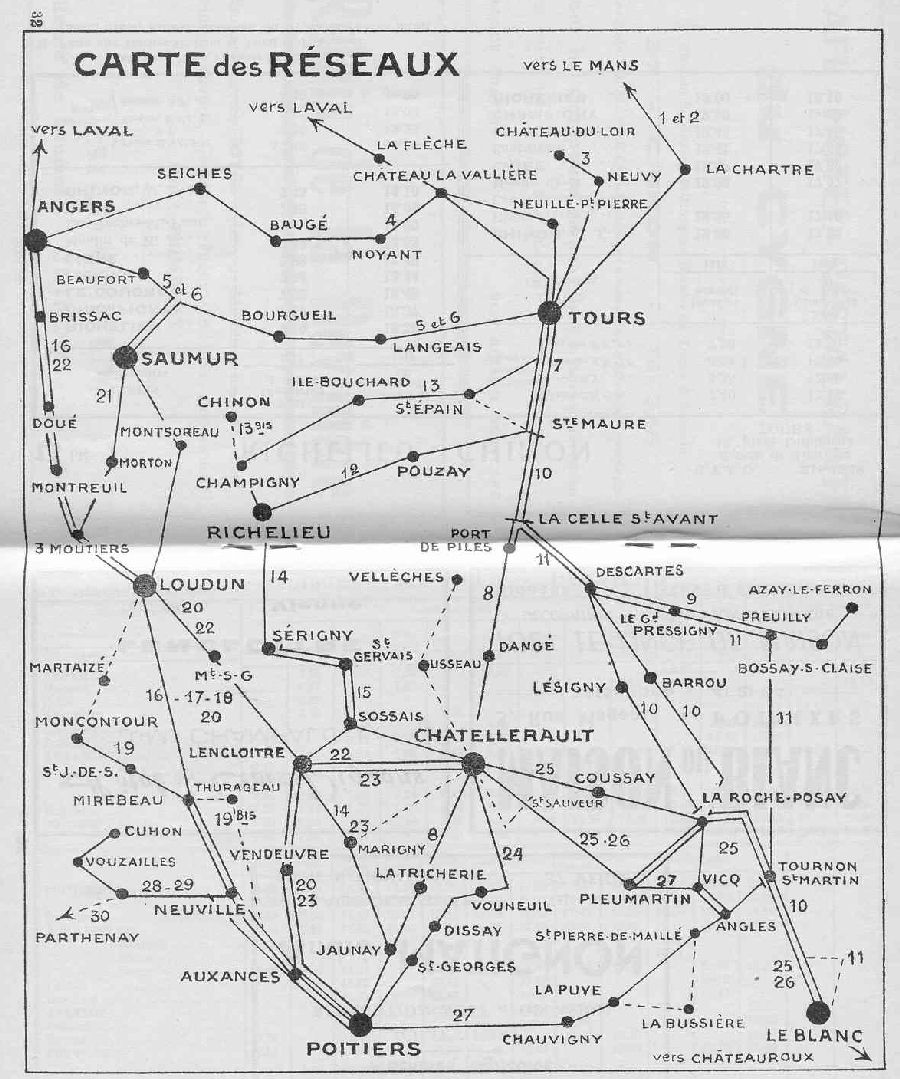
In 2011 there is a
comprehensive bus network Touraine
Fil Vert supported by the Conseil-Général serving Indre-et-Loire, whilst in
Vienne there is the Lignes en Vienne
network. The former is operated by Connex Ligeria, the local subsidiary of
Véolia Transport in Indre et
Loire, the latter by the Rapides de Poitou and Veolia Transport
Poitou-Charentes.
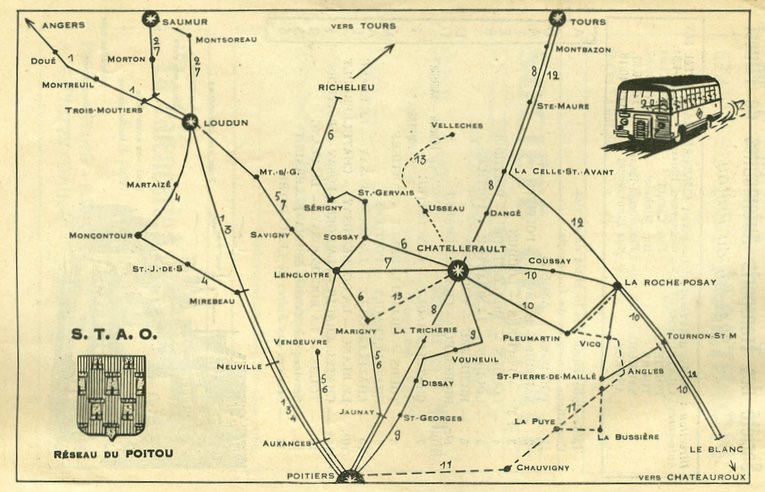
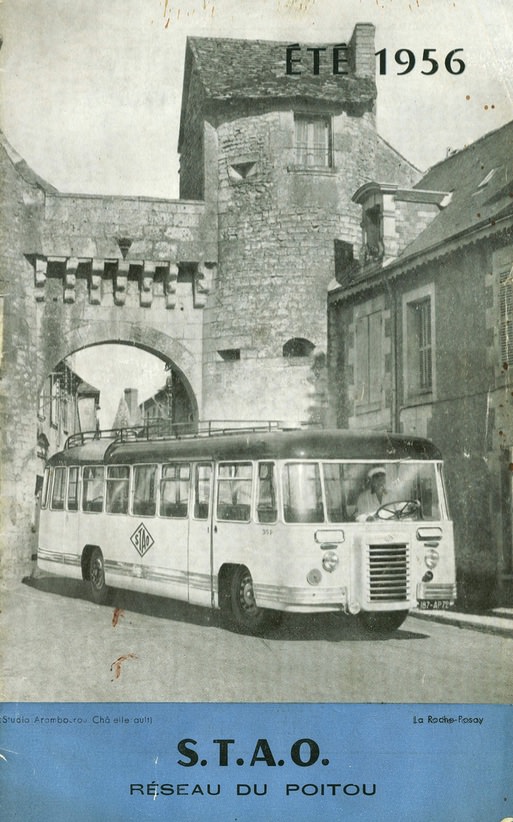
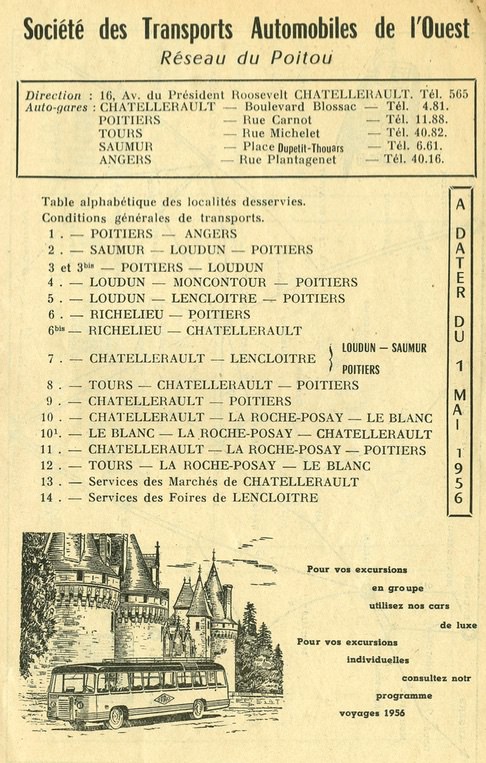
The two réseaux of Tours
(Indre-et-Loire) and Poitou (Vienne), which are believed to have been
developed in the 1930s, have usually been thought of together despite
being in two different departments. Traditionally they have
shared a common numbering system for their routes. For many years
there were two main country bus operators in the département of Indre-et-Loire. One
was the Verney group subsidiary STAO Société
es Transports Automobiles de l'Ouest, the
other was Les Rapides de Touraine,
both based on Tours. There was little overlap between the
routes of the two companies, and
both operator's routes departed from the Gare Routière in the Place de
la Gare at Tours railway station.
En
2011, il ya un vaste réseau de bus Touraine Fil Vert soutenu
par le Conseil-Général d'Indre-et-Loire, tandis que dans la Vienne, il
ya le réseau Lignes
en Vienne.
Le premier est assuré par Connex Ligeria, la filiale locale de Véolia
Transport dans l'Indre-et-Loire; et dans Poitou par les Rapides de
Poitou et aussi par Veolia Transport Poitou-Charentes.
Les
deux réseaux de Tours (Indre-et-Loire) et de Poitou (Vienne) sont
soupçonnés d'avoir été mis au point dans les années 1930, et ont
généralement été pensée en même temps tout en étant dans deux
départements différents. Ils ont partagé un système commun de
numérotation des lignes. Pendant de nombreuses années il y avait deux
opérateurs principaux d'autobus pays dans le département de
l'Indre-et-Loire. L'un était la Société des Transports Automobiles de
l'Ouest STAO filiale de groupe Verney, l'autre était Les Rapides de Touraine,
tous deux basés sur Tours. Il y avait peu de chevauchement entre les
lignes des deux compagnies, et les lignes des deux exploitants font
leurs départs de la gare routière de la Place de la Gare à Tours gare.
|
|
|
|
|
 |
|
 |
|
|
|
 |
|
|
|
 |
|
|
|
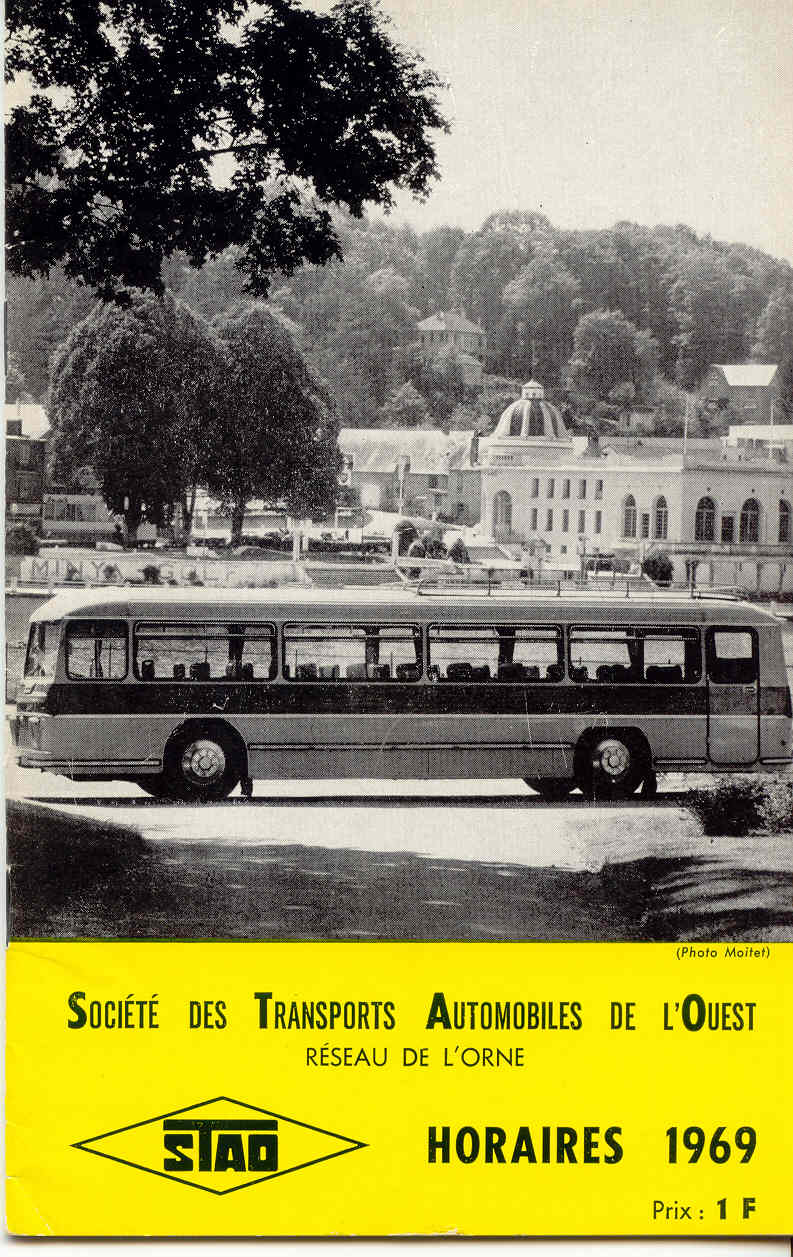
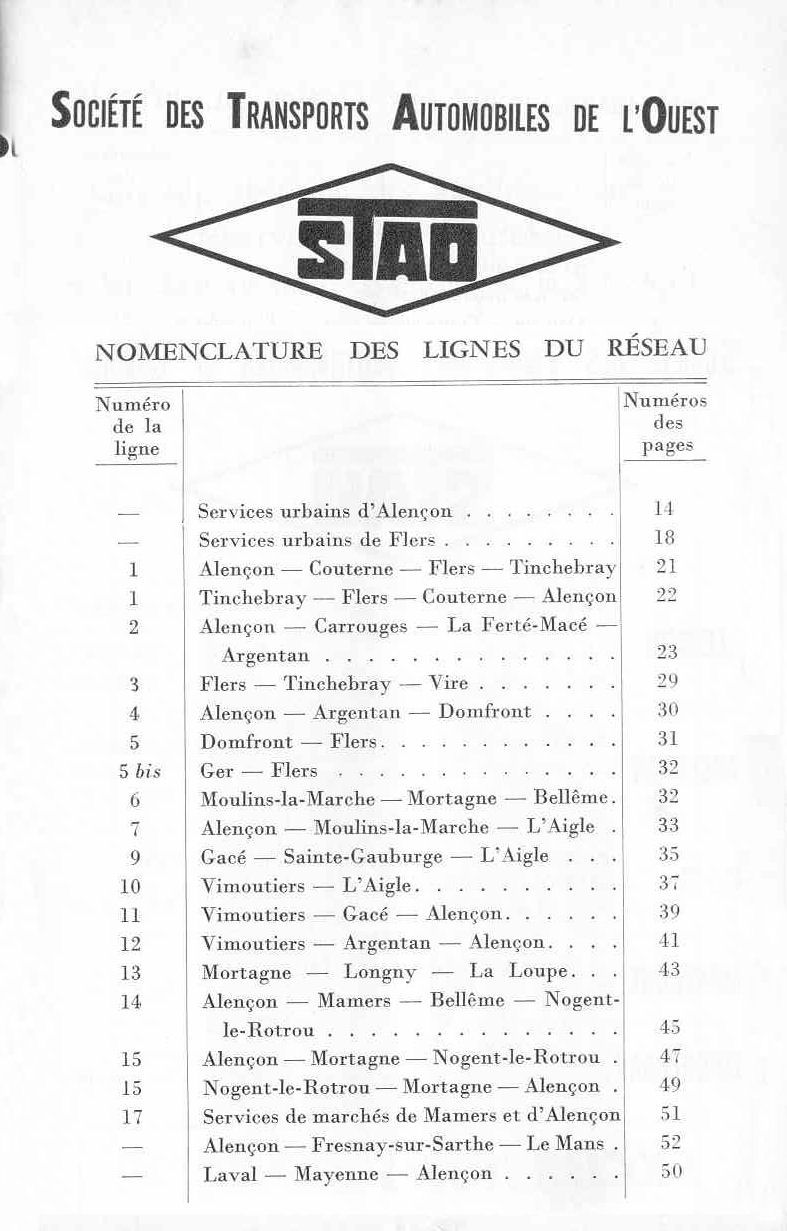
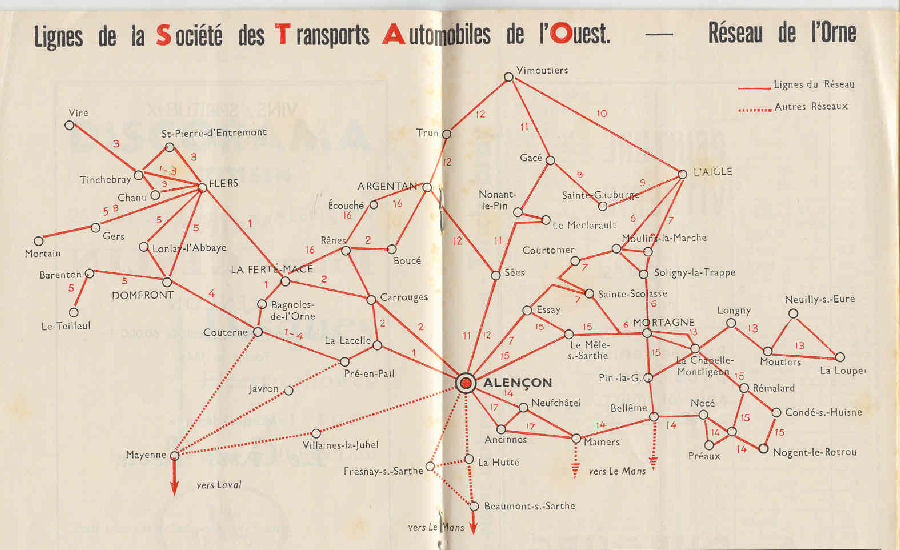
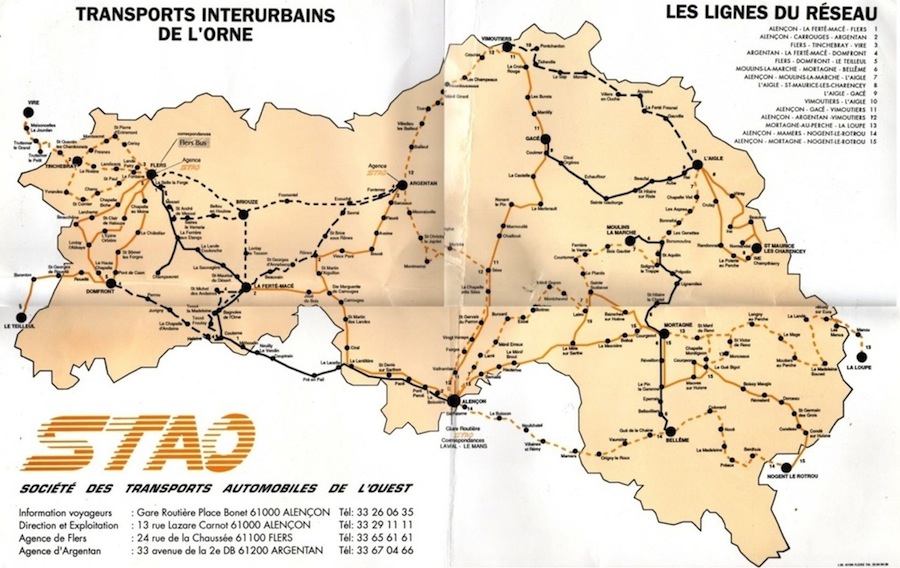
Dating from 2001,
the departmental network is Cap Orne
with 24 regular interurban bus lines based on the five principal
centres
of Alençon, Flers, Argentan, Mortagne-au-Perche and L’Aigle.
Veolia
subsidiary VTNI is one of the main providers with fifteen of the
routes.
From an original base of a few routes based on Alençon in 1933 further
routes were added as secondary rail lines closed in the 1930s and 1940s
and in the early 1960s four further routes were acquired from Autocars
du Pays d'Auge. Operations by STAO included the town services in both
Flers (since start-up in 1964) and Alencon.
Datant
de 2001, il y a le réseau départemental Cap Orne
avec 24 lignes régulières d'autocars interurbains au départ des cinq
principaux centres d'Alençon, Flers, Argentan, Mortagne-au-Perche et
L'Aigle. La filiale de Veolia VTNI est l'un des principaux exploitants
avec quinze lignes.
A
partir d'une base d'origine de quelques lignes basés sur Alençon en
1933, les routes supplémentaires ont été ajoutées sous forme de lignes
ferroviaires secondaires fermé dans les années 1930 et 1940 et dans les
années 1960 quatre lignes additionelles ont été acquis auprès Autocars
du Pays d'Auge. Les opérations STAO ont inclus les services urbains de
Flers (depuis son origine en 1964) et d'Alençon.
|
|
|
Since 2007 STAO is still an operator in 53-Mayenne, 72-Sarthe and
86-Vienne (Poitou)
Depuis 2007 STAO reste encore un
exploitant en 53-Mayenne, 72-Sarthe and 86-Vienne (Poitou) |
|
 |
|
 |
|
|
|
 |
 |
|
|
|
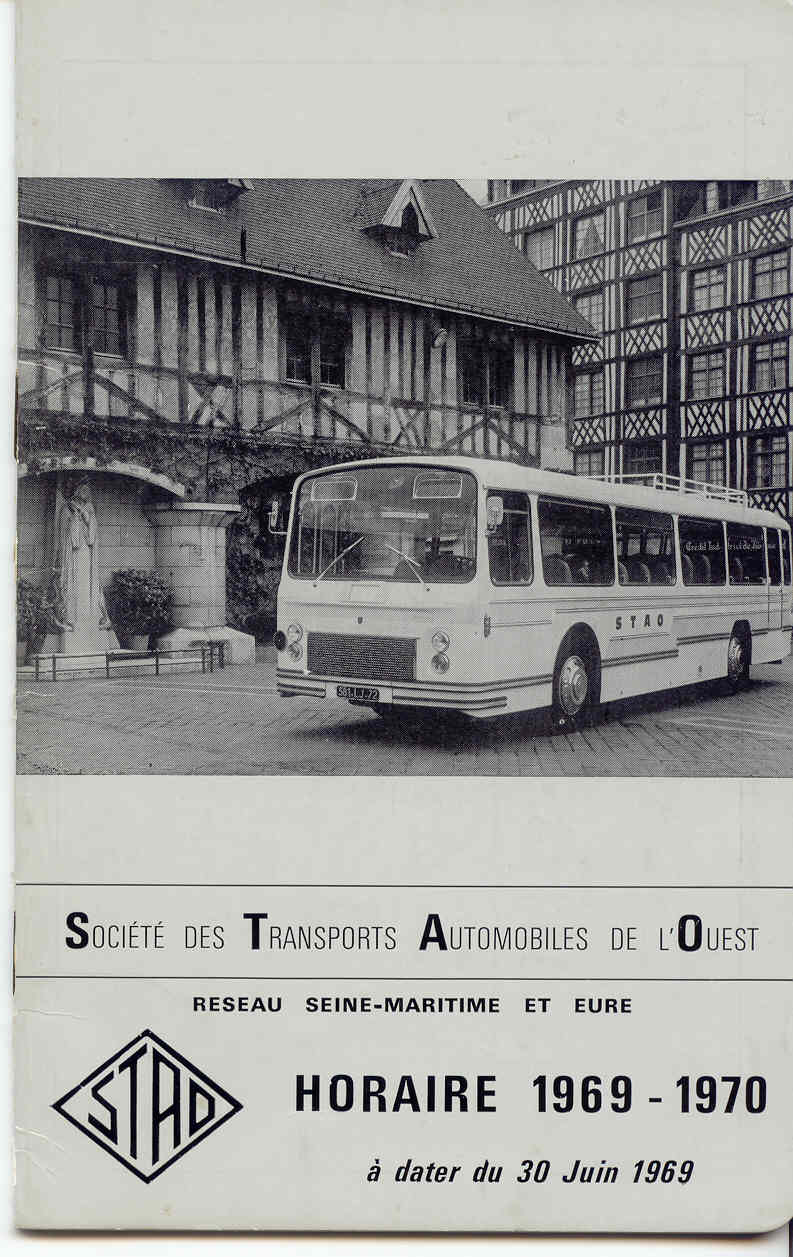
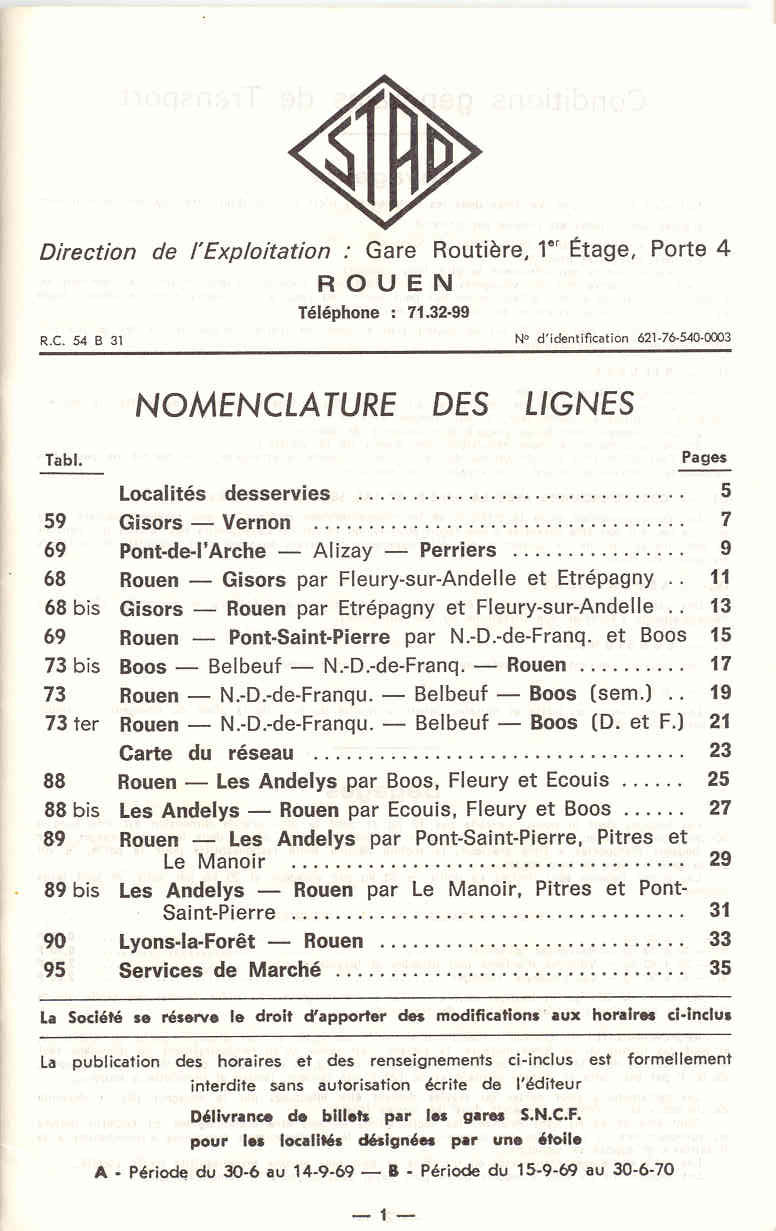
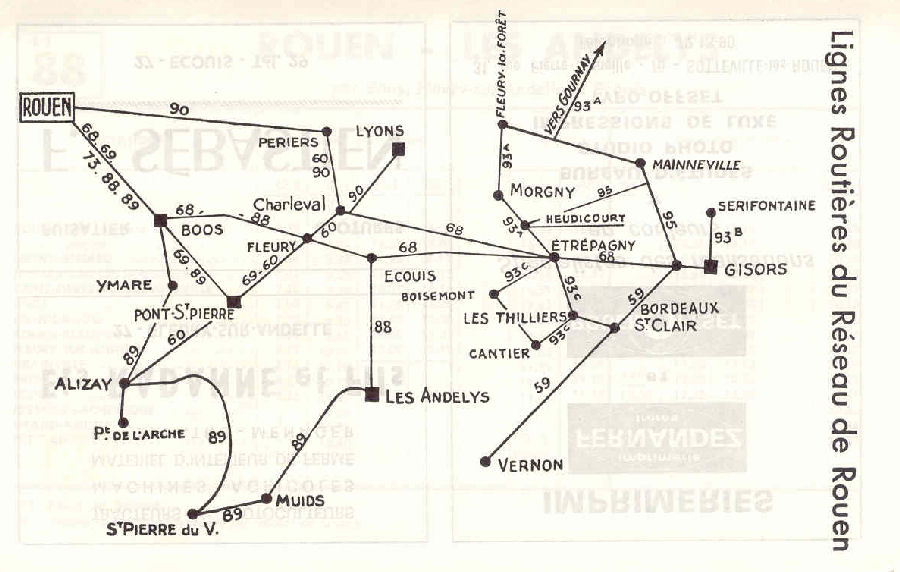
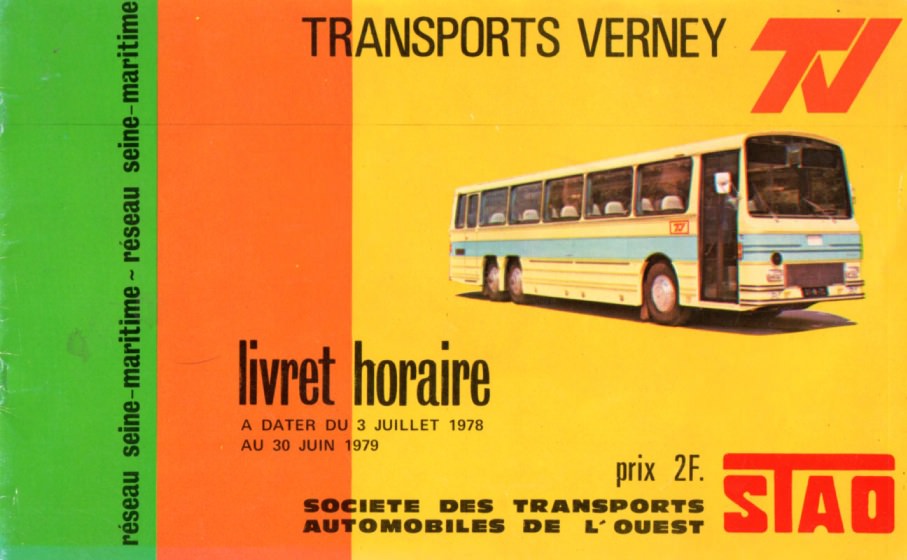
Dating from 2006
(if not considerably earlier) there is an extensive network
of bus routes supported by the department of Seine-Maritime. These
routes are provided by Compagnie Normande d'Autobus (now part of VTNI),
Keolis and
independent operators such as Hangard of Yvetot and Perier of Lillebonne. In Eure there is a network
of 30 regular lines serving 300 places. The origins of this branch of
the STAO are not known - it was isolated geographically from the other
STAO réseaux; it was in existence by 1946 and, unlike other STAO
networks, it did not develop from former secondary rail lines. However
the 'Indicateur Quillet' timetable of 1934 does not show any STAO
routes in the Rouen area.
Il
y a un vaste réseau
de lignes de car soutenus par le département de la Seine-Maritime, datant
de 2006 et probablement plus tot). Ces
lignes sont fournis par la Compagnie Normande d'Autobus (maintenant
connu comme VTNI), Keolis
et des opérateurs indépendants comme Hangard d'Yvetot et Périer de
Lillebonne. Dans l'Eure il y a un réseau
de 30 lignes régulières desservant 300 places. Les origines de ces
réseaux ne sont pas encore connues, mais déjà dans l'existence en
1946. Contrairement à d'autres réseaux de la STAO, le réseau
ne se développe pas d'anciennes lignes ferroviaires secondaires.
Cependant l'horaire 'Indicateur Quillet' de 1934 ne montre pas des
lignes STAO dans les alentours de Rouen.
|
|
|
|
|
|
|
|
 |
|
 |
|
|
|
 |
|
|
|
|
|
|
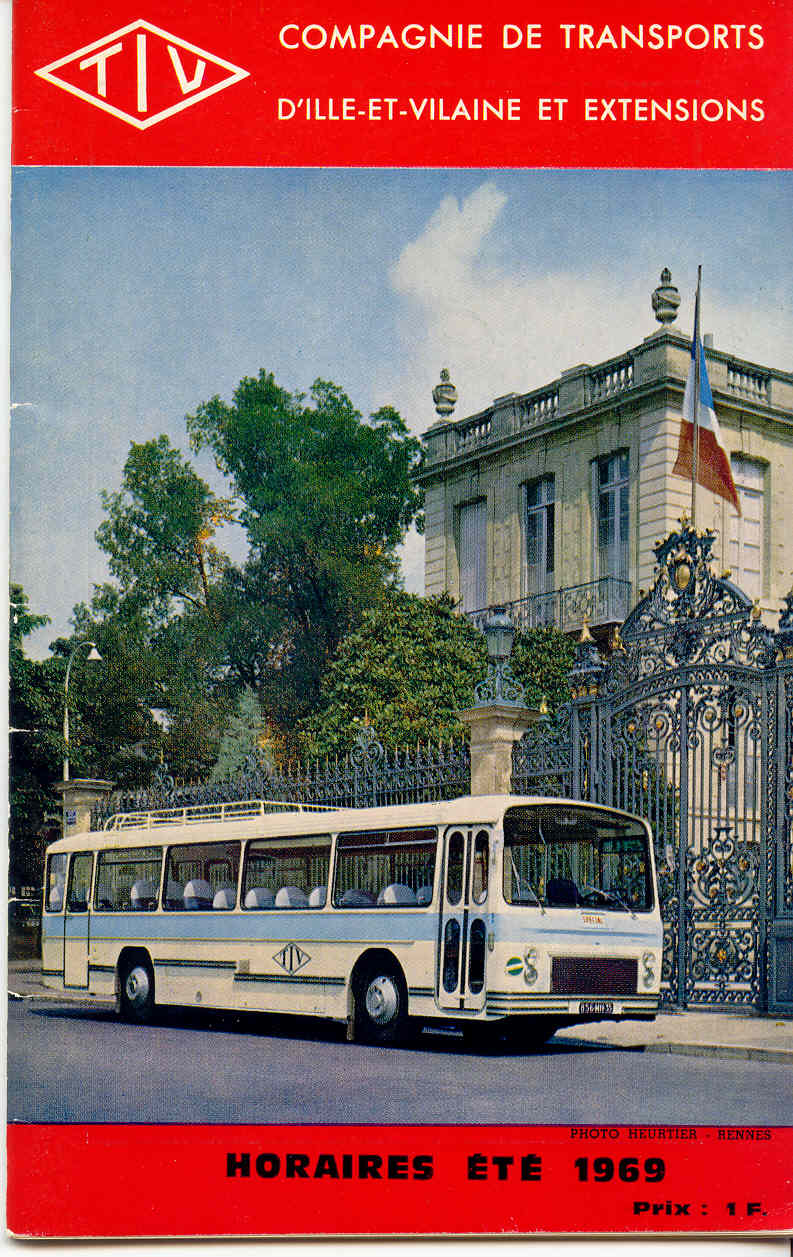
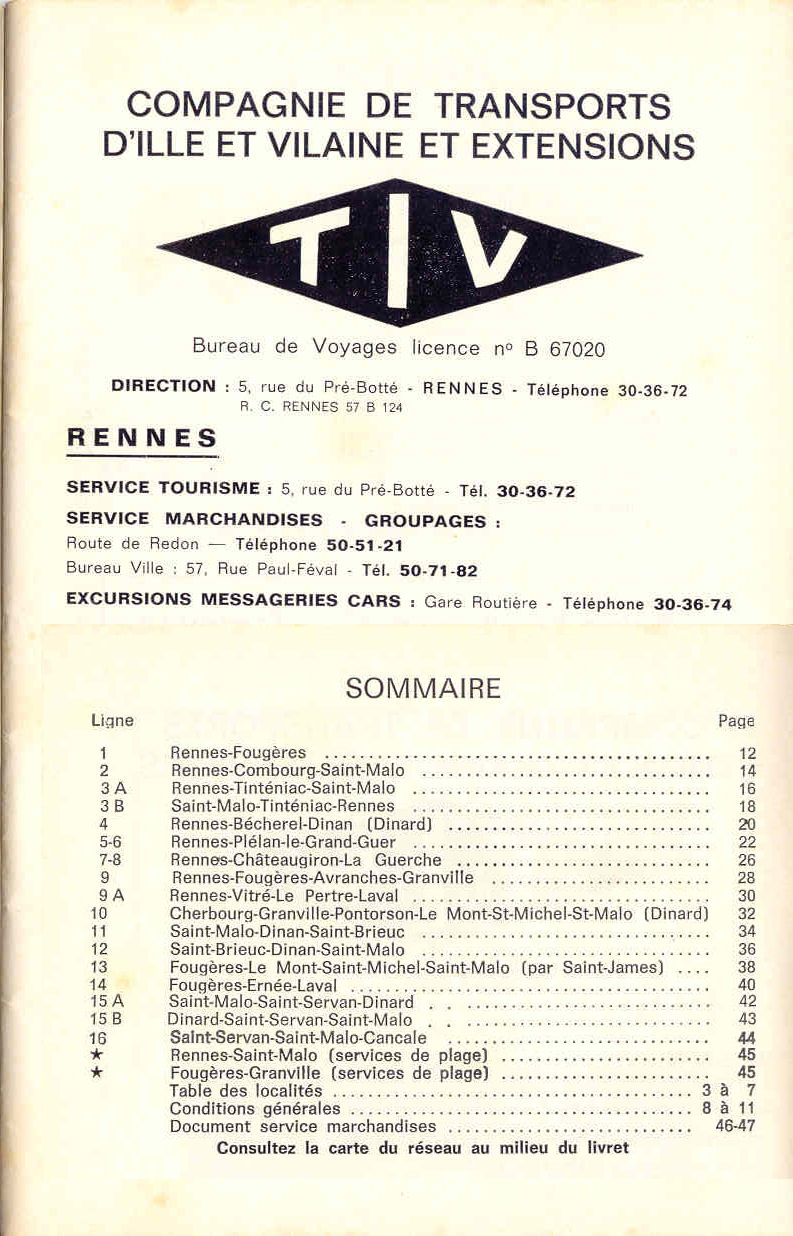
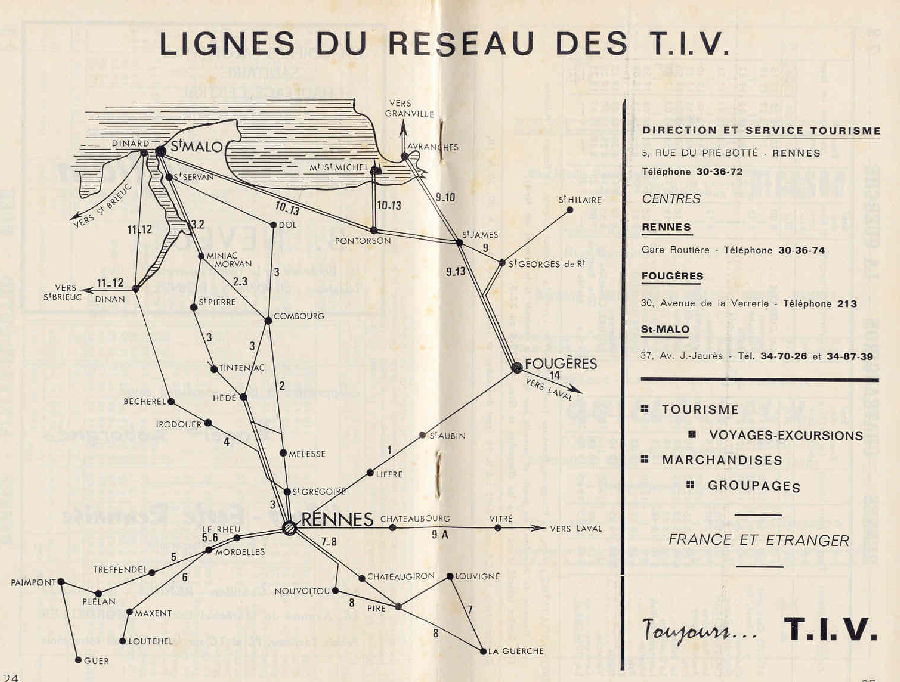
The network of bus
routes in Ille-et-Vilaine is now secured by the departmental
authorities under the name Illenoo.
A new innovation in 2011 is the direct operation of some of the Illenoo
routes by a departmentally owned subsidiary Illevia.
Based at Noyal Châtillon sur Seiche to the south of Rennes with 50
buses, Illevia is expected to generate substantial savings. This will
be one quarter of the network of public transport. The remaining three
quarters will
remain assigned to private carriers, wherever possible regional
companies. In the summer of 2011 TIV lost the
contract for operating the Illenoo network to Kéolis.
The origins of Tramways d'Ille et
Vilaine
lie in May 1896 with local rail lines. By 1910 the network extended
from Rennes to Bécherel, Antrain sur Couesnon, Pleine Fougères and St
Malo. In the 1930s excursion trains were put into operation in
the summer
with great success to destinations like the forest of Paimpont or
the seaside at Saint Malo. Through the constant rise of the
automobile,
resulting in a steady decline in patronage, from the
1950s the bus takes over from the train.
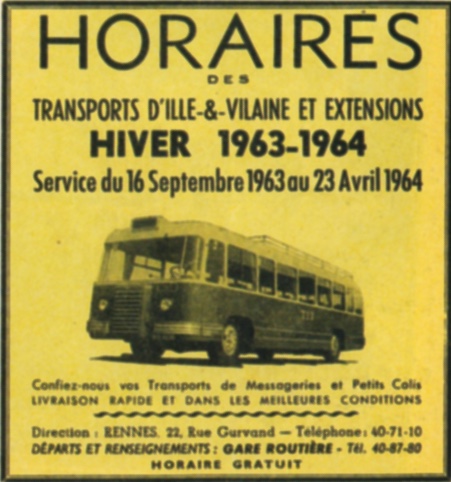 |
TIV maintain their well known
name, meaning now Transports d'Ille
et Vilaine et extensions.
In 1958 Verney acquired SAFTA (société anonyme fougeraise de transport
automobile) and Cars Bleus (in Saint Malo). These combined as SAFMAT
which in turn became part
of TIV in 1965, denoting the final integration of the new combined
entity in the Verney group. In 1968, further growth occurred when
the Conseil Général sold Tramways Breton of Saint Malo to the TIV. In
November 1996 the centenary of TIV was celebrated in grand style, with
Verney directors and the Mayor of Rennes. In
January 2002, Verney
joined the Connex group, later Veolia Transport, and now TIV is a
TransDev company. |
|
Le
réseau de lignes de cars en Ille-et-Vilaine est maintenant assuré par
les autorités départementales sous le nom ILLENOO.
Une nouvelle innovation en 2011 est l'exploitation directe de certaines
des lignes ILLENOO par un filiale <ILLEVIA> appartenant au
département.
Basée à Noyal Châtillon sur Seiche au sud de Rennes avec 50 cars,
Illevia devrait générer des économies substantielles. Ce sera un quart
du
réseau de transports en commun. L'autre trois quarts resteront exploité
par les
transporteurs privés, autant que possible les entreprises régionales.
L'été de 2011 TIV a perdu le contrat pour l'exploitation
du réseau ILLENOO à Kéolis.
|
Les
origines de Tramways d'Ille-et-Vilaine débutent mai 1896 avec des
lignes ferroviaires locales. En 1910, le réseau étende de Rennes à
Bécherel, Antrain sur Couesnon, Pleine Fougères et St Malo. Dans les
années 1930 trains d'excursion ont été mis en service à l'été avec un
grand succès pour les destinations comme la forêt de Paimpont ou le
bord de mer à Saint-Malo. Grâce à l'augmentation constante de
l'automobile, ce qui entraîne une baisse régulière de la fréquentation,
à partir des années 1950 le car prend le relais du train. TIV conserver
leur nom bien connu, ce qui signifie maintenant Transports d'Ille et
Vilaine et Extensions. En 1958 Verney acquis SAFTA (société anonyme
fougeraise de transport
automobile) et Cars Bleus (Saint-Malo). Elles sont combinés comme
SAFMAT qui à son tour fait partie de TIV en 1965, ce qui dénote
l'intégration définitive de la nouvelle entité combinée dans le groupe
Verney. En 1968, la croissance s'est accentué lorsque le Conseil
Général a vendu Tramways Breton de Saint-Malo à la TIV. En Novembre
1996, le centenaire des T.I.V. est feté
en grandes pompes réunissant les personnalités
locales, le président Verney et ses collaborateurs ainsi
que le Maire de Rennes. En Janvier
2002, Verney a rejoint le groupe Connex, puis Veolia Transport, aujourd'hui TIV est filiale de TransDev.
|
|
|
|
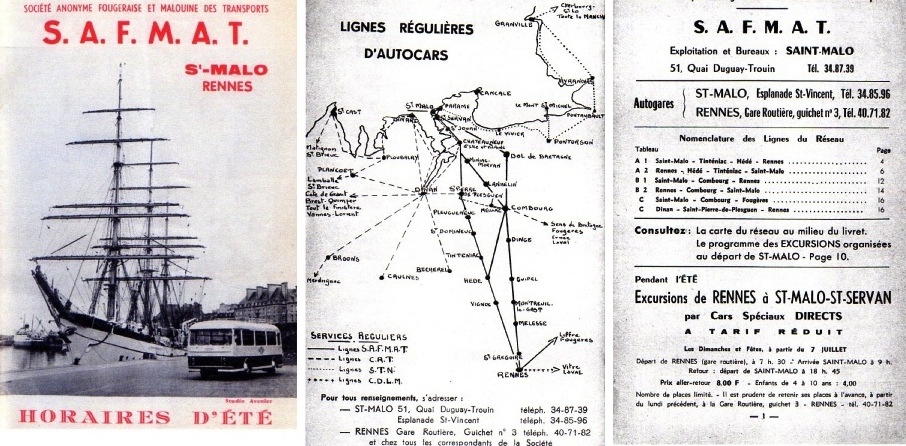
SAFMAT timetable from summer 1963 for
Saint Malo to Rennes routes
|
|
|
|
|
|
|
|
|
|
|
|
|
|
|
|
|
|
 |
|
 |
|
|
|
 |
|
|
|
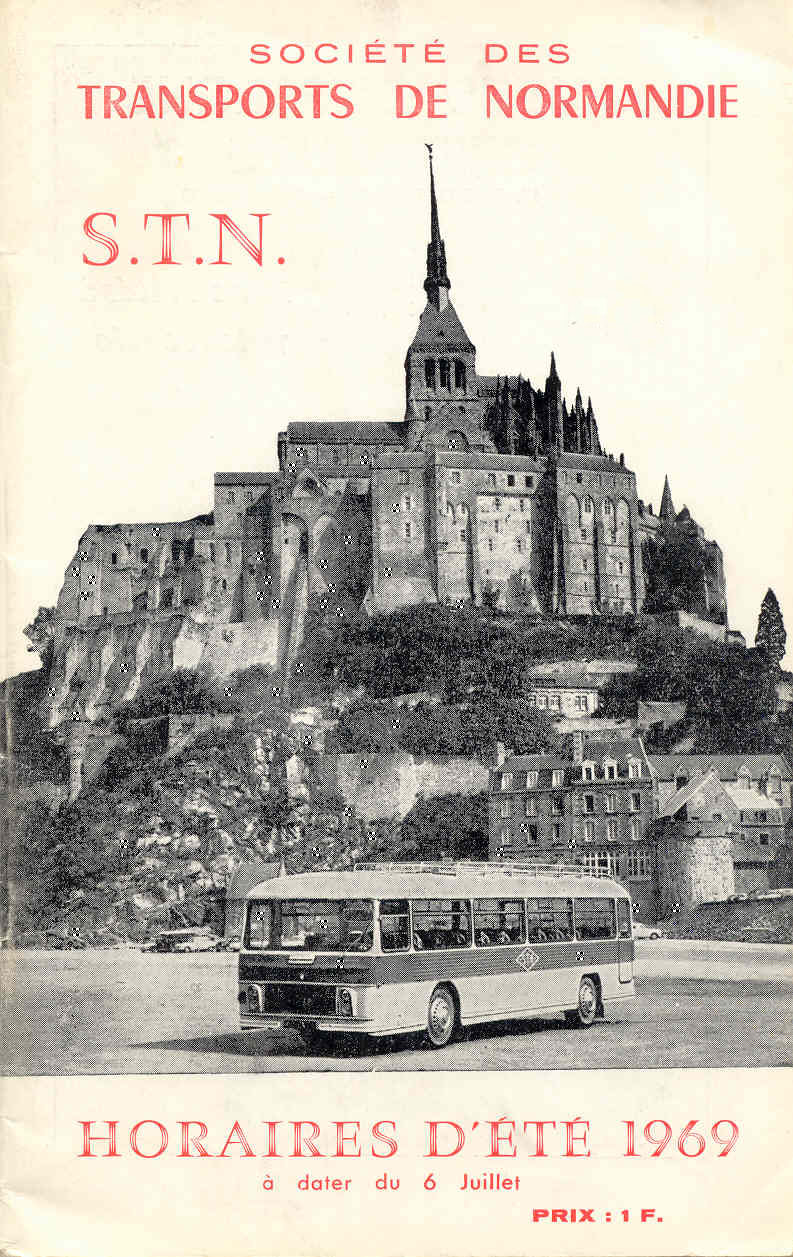
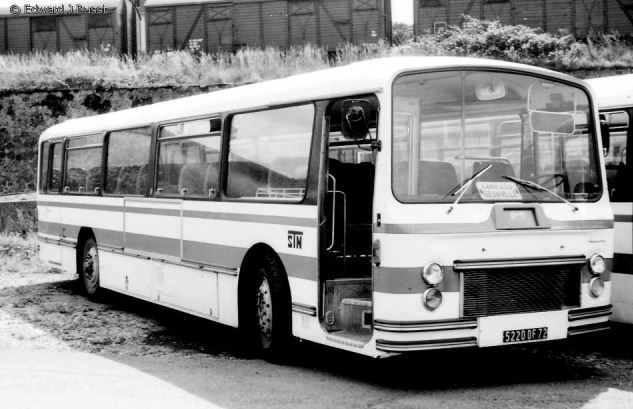
Verney bus of STN seen at Granville
station in
1984. Many buses of the subsidiary companies were registered
in the department of Sarthe (72) where the Verney group head office in
Le Mans was situated.
Car Verney de la STN à la
gare de Granville en 1984. Nombreux cars des sociétés filiales ont été immatriculés
dans le département de la Sarthe (72) dont le siège social de la groupe
Verney était situé au Mans.
(photographe
de Edward J Busst, busglobe)
|
|
There
were
originally three local rail
companies in the département of la Manche: Tramways Normands
(TN), Chemins de Fer Départementaux (CFD), and Chemins de
Fer de
la Manche (CFM). CFD and CFM were in financial difficulty by
1925
and it was agreed that TN take over all of the local
railways. TN
became the Compagnie des Chemins de Fer Normands (CFN)
in 1928, operating both trains and buses as part of the Verney
group. Many of the local rail lines
closed in the 1930s, except the standard gauge lines in the Barfleur
area.
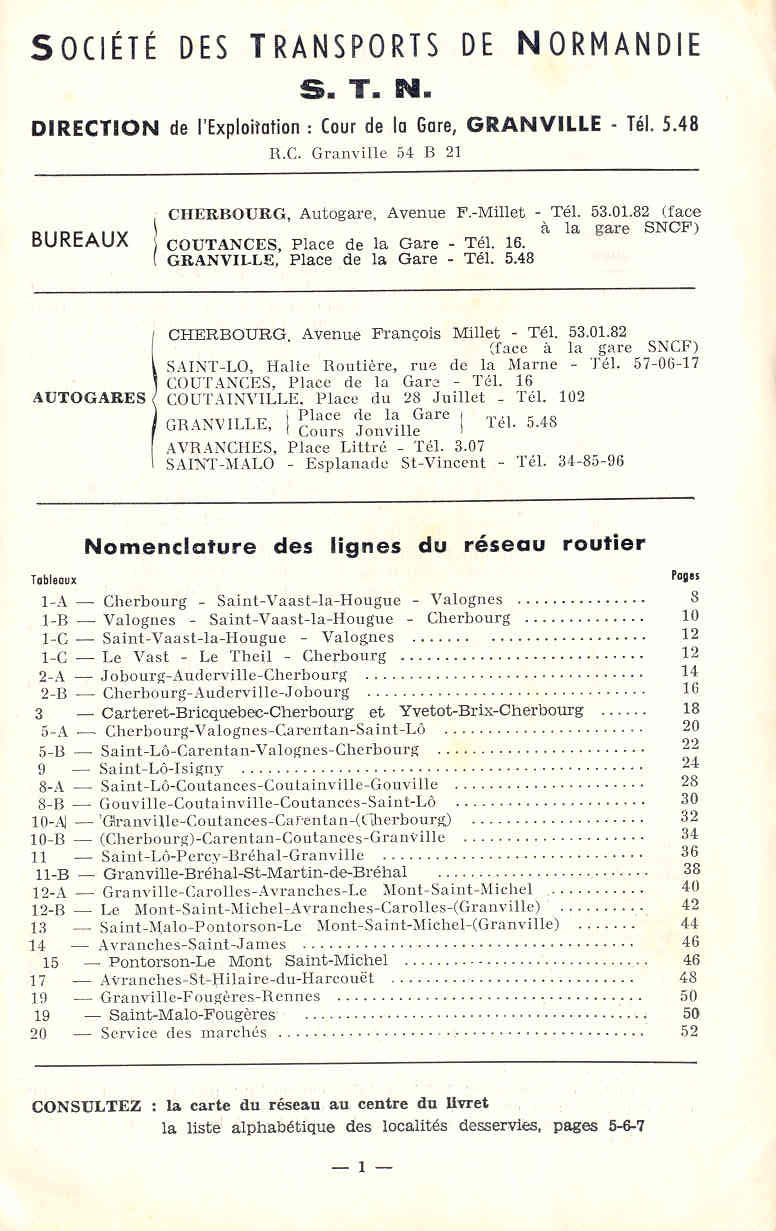
The Société des Transports de
Normandie
(STN) was set up in June 1943 - originally as a road freight
company
only (as passenger operations continued under the CFN name). The
last local rail service ceased on 30th September 1950 (the
"Tue-Vaques" from Cherbourg to Barfleur), then it was buses only.
STN expanded
into road passenger services by
taking over the CFN buses in 1953. In February 1957
the
routes of the SGTD Société des Transports Départementaux
de la Manche merged with STN, bringing together the two local
networks. Since
September 2007 Manche has had a departmental
network
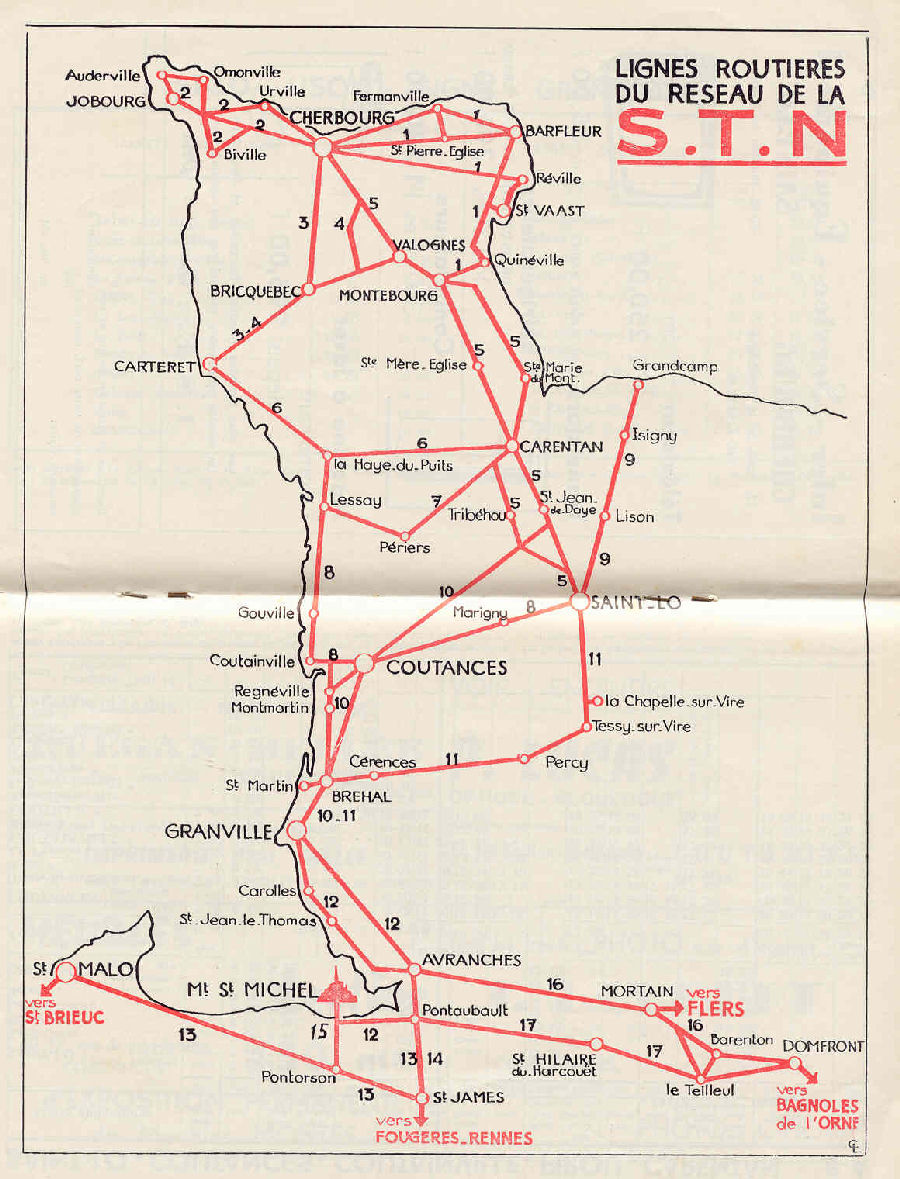
called manéo. Six main
interurban services linked the principal towns, plus twenty seven
feeder
services connecting with the main routes. The main
contractor who gained the tender for the operation of the
network was Veolia subsidiary VTNI.
Some routes are sub-contracted. STN
- as a Verney subsidiary -
joined the Connex group in 2002, now part of Veolia Transport, which
operates locally as VTNI. A substantial revision of the Manéo
network took place in summer 2012 and Veolia is no longer the only
operator.
Il
y avait à l'origine trois compagnies ferroviaires locales dans le
département de la Manche: Tramways Normands (TN), Chemins de Fer
Départementaux (CFD) et Chemins de Fer de la Manche (CFM). CFD et CFM
étaient en difficulté financière en 1925 et il a été convenu que TN
prend en charge l'ensemble des chemins de fer locaux. TN devient la
Compagnie des Chemins de Fer Normands (CFN) en 1928, l'exploitant des
trains et des autobus dans le cadre du groupe Verney. La plupart des
lignes ferroviaires locales ont été fermé dans les années 1930, à
l'exception des lignes à voie normale dans la région de Barfleur.
La Société des Transports de
Normandie (STN) a été créé en Juin 1943 - à
l'origine comme une entreprise de transport routier seulement (avec le
transport de voyageurs continuant sous le nom CFN). La dernière service
ferroviaire locale a cessé le 30 Septembre 1950 (la «Tue-Vaques" de
Cherbourg à Barfleur), alors qu'il était seulement des cars. STN s'agrandit dans les services de transport
routier de personnes en prenant
en charge les cars CFN en 1953. En Février 1957, les lignes de la
Société des Transports Départementaux SGTD de la Manche a été fusionné
avec STN, réunissant les deux réseaux locaux. Depuis
Septembre 2007 la Manche a un réseau départementale
appelé manéo. Six
lignes interurbains principaux entre les grandes villes, ainsi que 27
services locales en raccordement avec les lignes principales.
L'exploitant principal qui a gagné l'appel d'offres pour l'exploitation
du réseau était Veolia une filiale de VTNI. Certaines lignes étaient
sont sous-traités. STN - en
tant que filiale
Verney - a rejoint le groupe Connex en 2002, faisant maintenant partie
de Veolia Transport, qui exploite localement sous l'appellation
VTNI. Une révision substantielle du réseau Maneo a lieu à l'été
2012 et Veolia n'est plus le seul opérateur.
|
|
|
|
|
|
|
|
 |
|
 |
|
|
|
 |
|
|
|
 |
|
 |
|
|
|
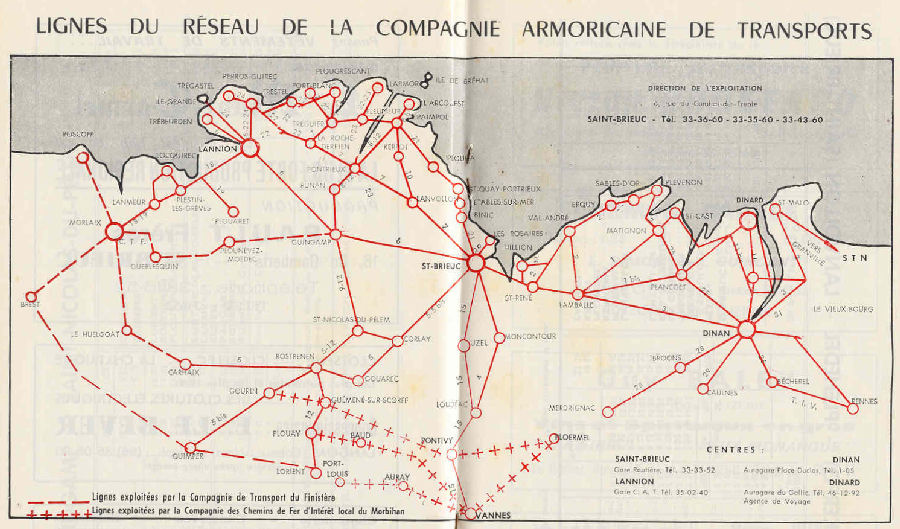 |
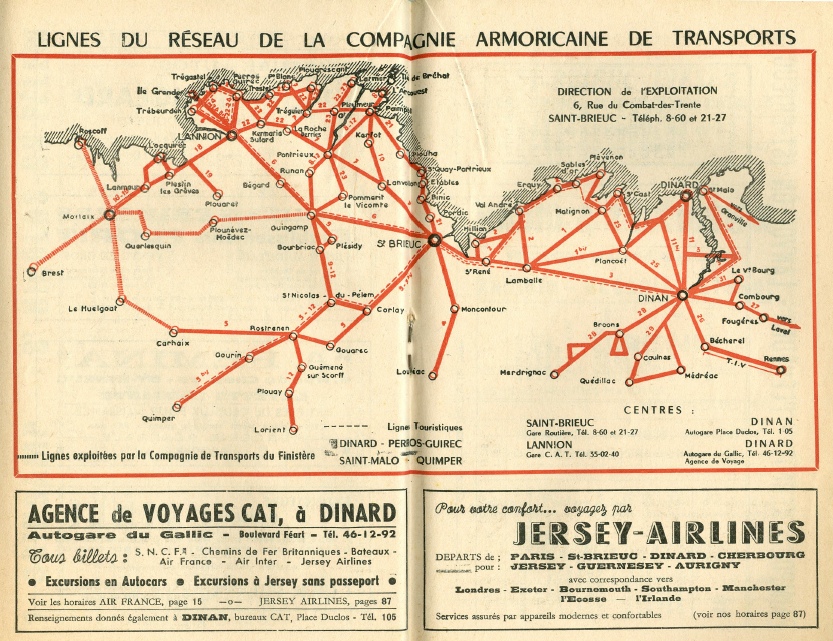
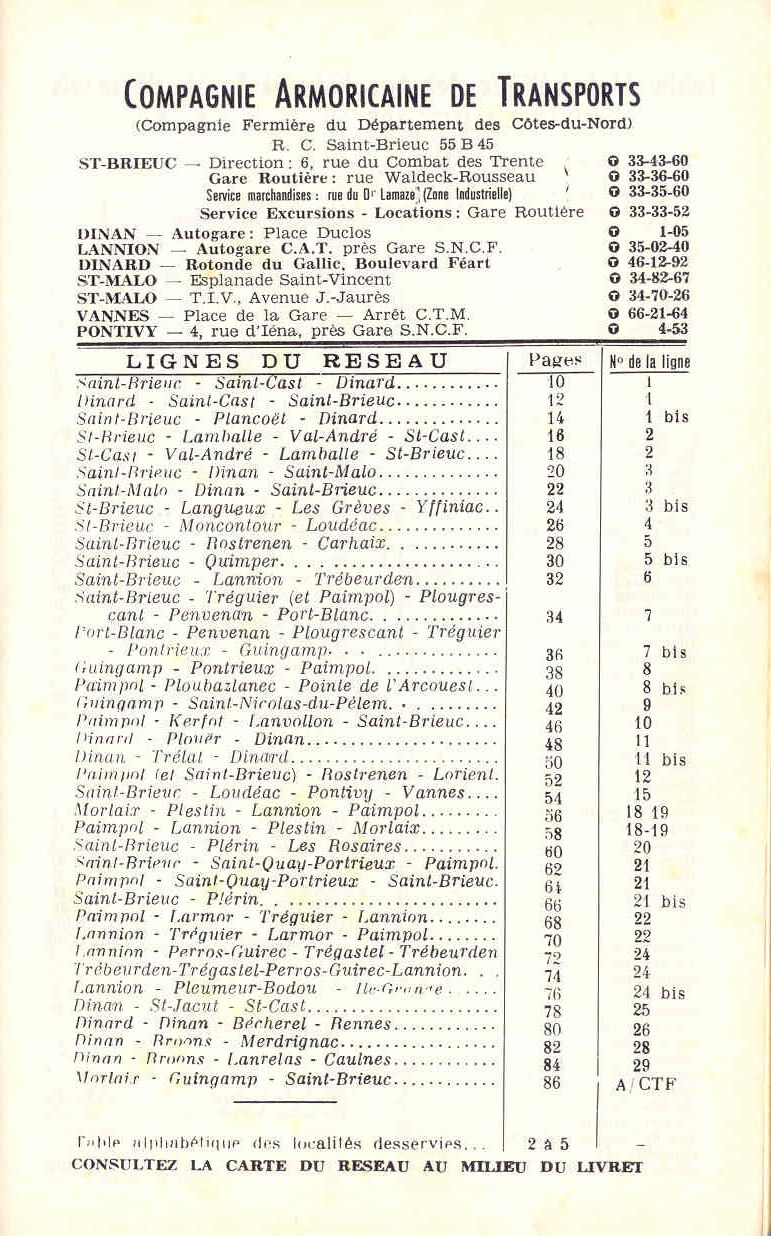
From
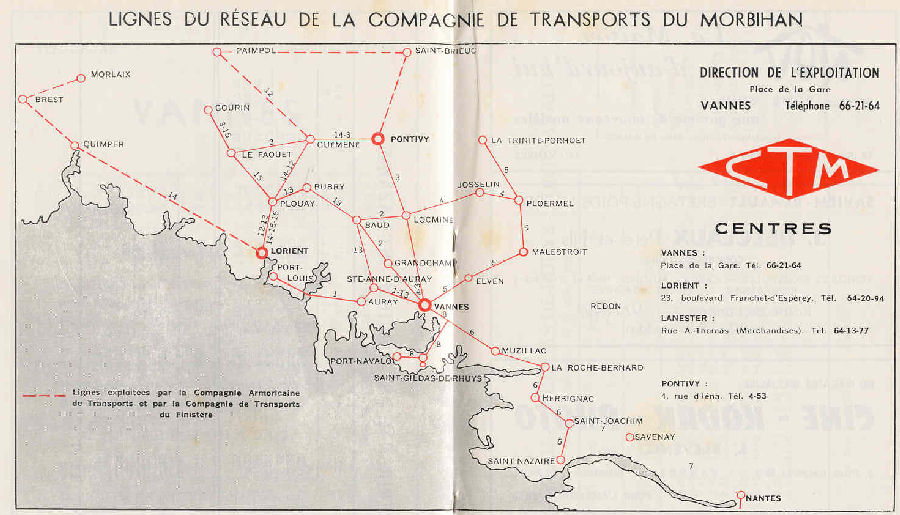
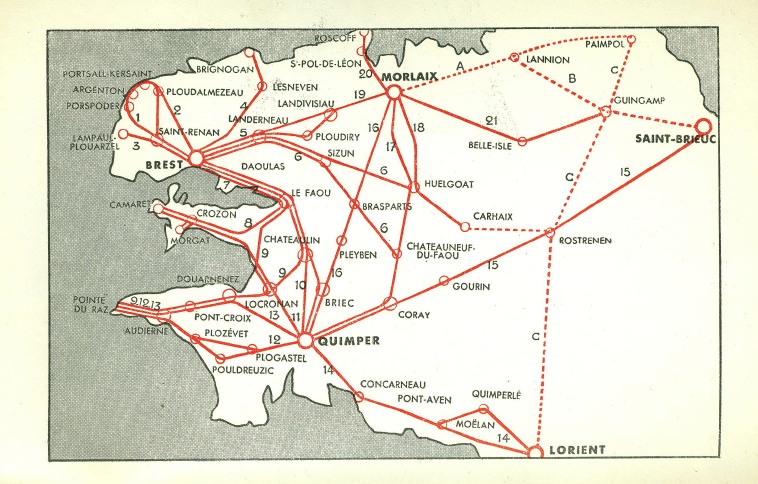
the 1969 map and list of routes above the following CAT lines were
specifically listed as being leased (affermées) from the department of
Côtes du Nord by an agreement dated 17 August 1956:
Sur le plan
1969 et liste des routes au-dessus les lignes de CAT suivants ont fait
l'objet d'une convention d'affermage avec le département des Côtes du
Nord en date du 17 août 1956:
2
Saint-Brieuc et Lamballe - Val-André
-
Saint-Cast
21 Saint-Brieuc - Saint-Quay-Portrieux - Paimpol
22 Paimpol - Tréguier et
Larmor -
Lannion
23 Lannion - Perros-Guirrec - Tregastel
|
|
|
|
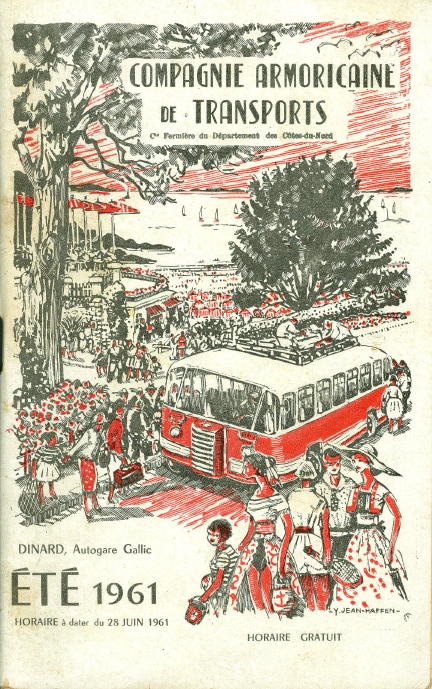
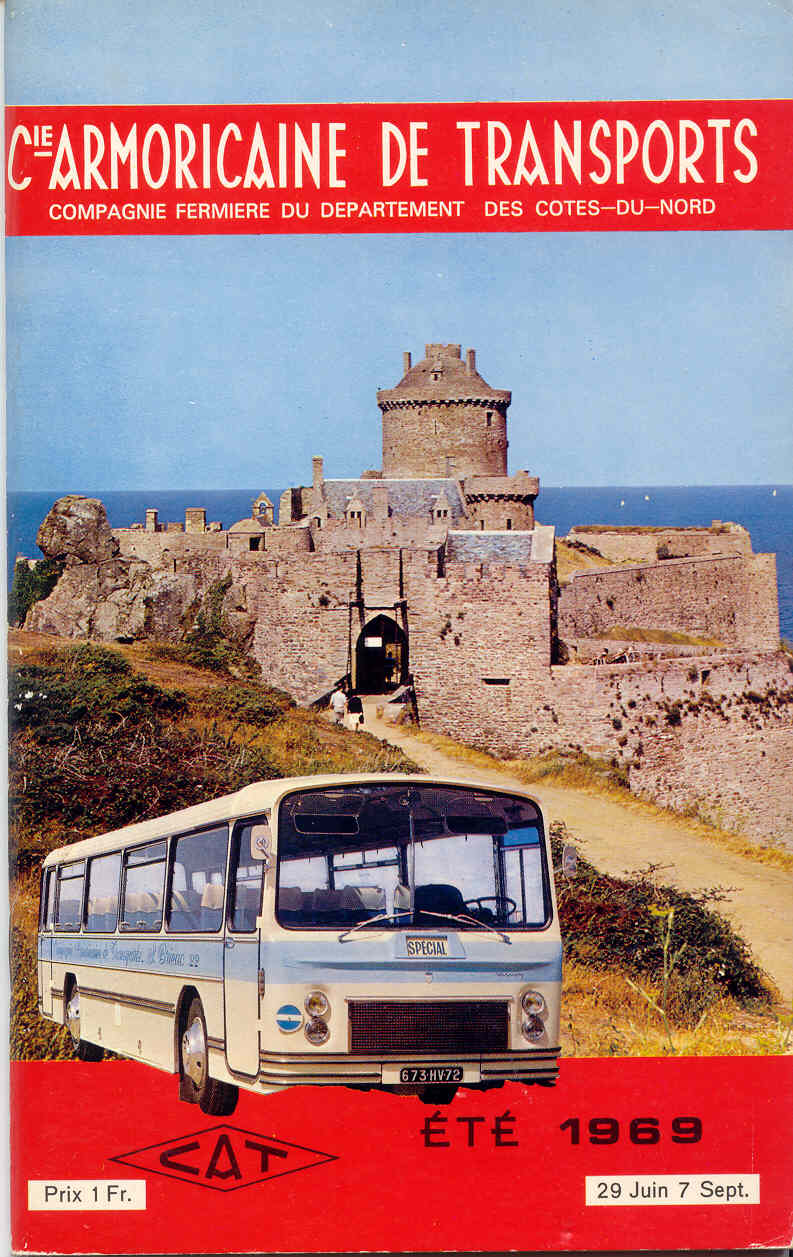
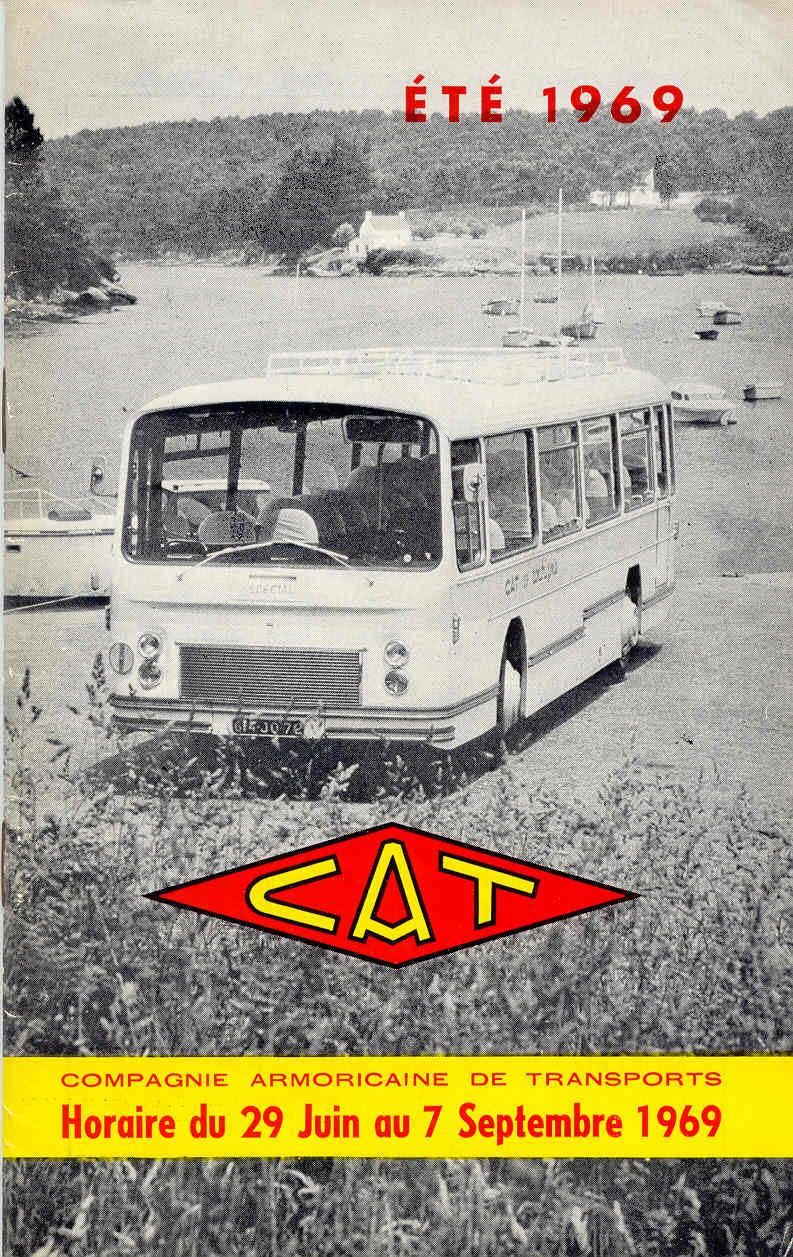
In 2011 there is
the network Tibus
in the Côtes d'Armor, and CAT Compagnie Armoricaine de Transports (a
Veolia subsidiary) is one of the principal providers based at St
Brieuc, Dinan and Lannion.
The
origins of CAT are believed to have
grown from a company established in 1933 and jointly owned by
SCF-Verney and Citroën: SAT Société Armoricaine de
Transports (Compagnie Armoricaine de Transports Citroën from 1933 to
1941). From 1933 some of the original secondary rail lines were taken
over directly by the department, but all their bus operations ceased in
1956 (as above) and except for two lines were transferred to Compagnie
Fermière du
Département des Côtes du Nord. The subsequent title CAT Compagnie
Armoricaine de
Transports was in use by 1948 and was widely employed as named operator
for the Verney group across the department by at least 1961 or
1962. In 1968 CAT took over operation of the town
services in St Brieuc but the concession passed to Transexel in 1990.
En
2011, il ya le réseau Tibus
dans les Côtes d'Armor, et la Compagnie Armoricaine Transports CAT (une
filiale de Veolia) est l'un des principaux exploitants basés à
Saint-Brieuc, Dinan et Lannion.
On
croit que les origines de la CAT sont une société créée en 1933, propriété
conjointement de la SCF-Verney et Citroën: SAT Société Armoricaine de
Transports (Compagnie Armoricaine de Transports Citroën de 1933 à
1941).A partir de 1933 une partie des lignes ferroviaires
secondaires d'origine ont été prises en charge directement par le
département, mais toutes leurs opérations de cars ont cessé en 1956
(comme ci-dessus) et
à l'exception de deux lignes ont été transférées à la Compagnie
Fermière du Département des Côtes du Nord. L'appellation suivante
Compagnie
Armoricaine de Transports CAT était en usage en 1948 et a été largement
utilisé comme exploitant nommé pour le comte de la groupe Verney dans
le département d'au moins 1961 ou 1962. Depuis 1968 CAT a également
exploité les services urbains de Saint-Brieuc
avant que la concession a passée à Transexel en 1990.
|
 |
|
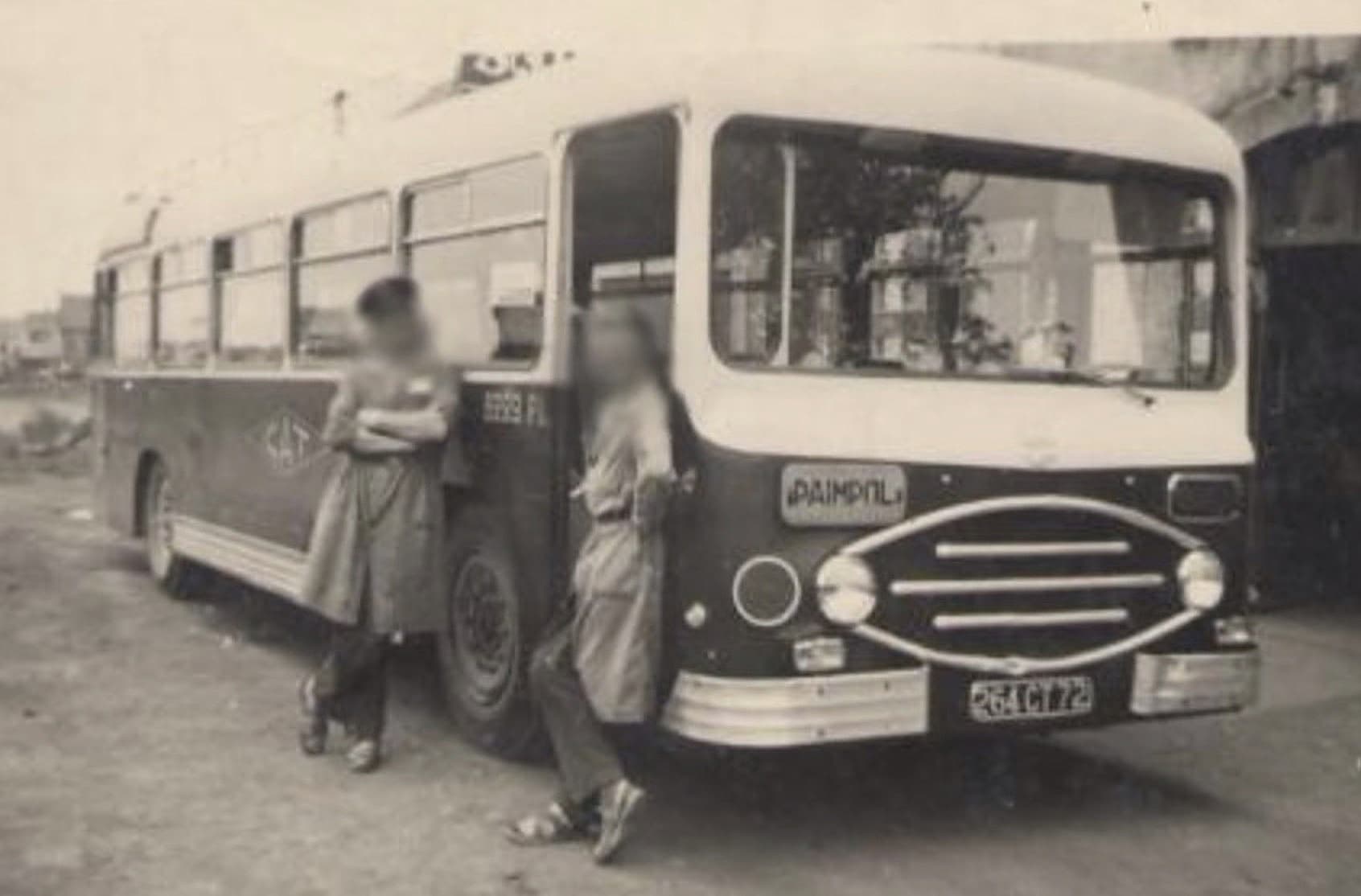
On
attend le depart pour Paimpol
Waiting for the departure to Paimpol
|
|
|
|
|
|
|
|
 |
|
 |
|
|
|
re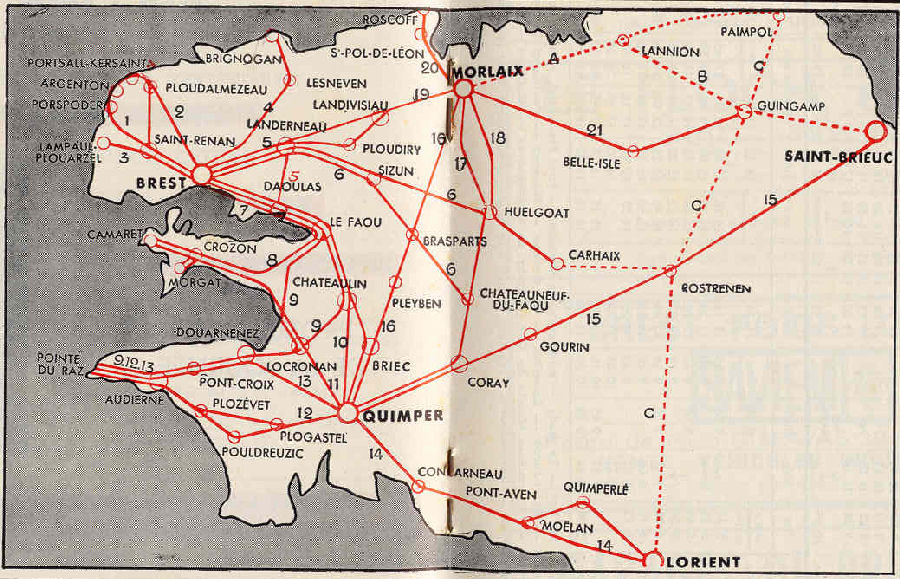 |
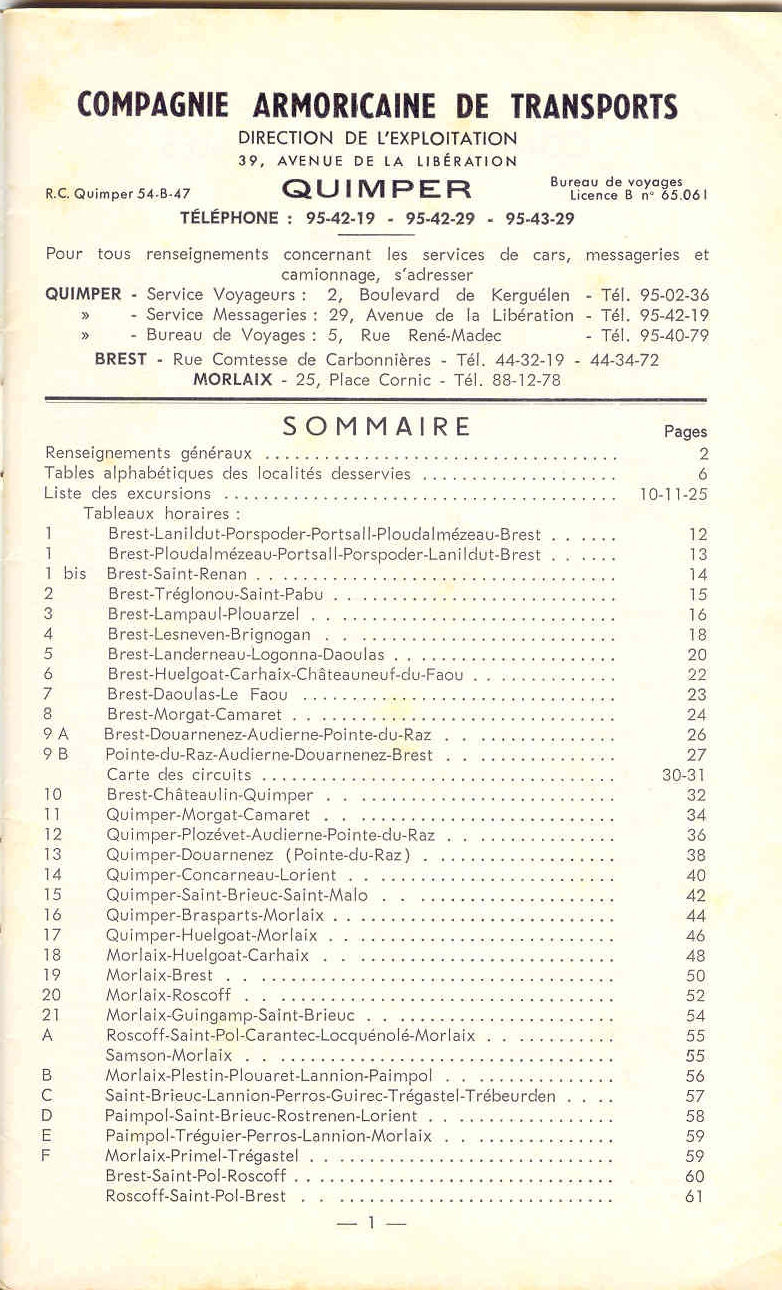
In 2011 there is Réseau Penn-ar-Bed
with 48 regular lines provided by 14 operators.
Originally there was the bus operator Compagnie de Transports du
Finistère (CTF - see below) and before that the Compagnie des Chemins
de Fer
Départementaux du Finistère (CFDF) who were a Beldant-Baert subsidiary
running secondary rail lines in the department from as early as
1891. CFDF took over other secondary lines on behalf of the
department in 1922 but following disagreement in 1935 the department
took the lines back under their own operation. Previous to that a
Verney subsidiary bus company CTF had been established, which absorbed
in 1933 the local operations of two national group operators: the
Compagnie Armoricaine de Transports Citroën and the Société Automobile
de Transport Finistérien (SATAF - a Renault subsidiary). In 1962 CTF
became known as Compagnie Armoricaine de Transports - Réseau de
Finistère, a subsidiary of the CAT of St Brieuc in the neighbouring
department of Côtes du Nord (although timetable covers still show CTF
as late as 1966). |
En
2011, il ya le Réseau Penn-ar-Bed, avec 48 lignes régulières fournies par
14 entreprises.
A
l'origine il y avait l'exploitant des cars Compagnie de Transports du
Finistère (CTF - voir ci-dessous) et avant ca la Compagnie des Chemins
de Fer Départementaux du Finistère (CFDF) qui étaient une filiale
Beldant-Baert assurant des lignes ferroviaires secondaires dans le
département dès 1891. CFDF prend le relais sur les autres lignes
secondaires pour le compte du département en 1922, mais un désaccord à
la suite, en 1935, le département a repris les lignes sous leur propre
fonctionnement. Avant cela, une filiale Verney des autocars de la
compagnie CTF avait été mis en place, qui a absorbé en 1933 les
opérations locales de deux opérateurs nationaux: la Compagnie
Armoricaine de Transports Citroën et la Société Automobile de Transport
Finistérien (SATAF - une filiale de Renault). En 1962, la CTF devient
connu
sous le nom de la Compagnie de Transports Armoricaine - Réseau de
Finistère, une filiale de la CAT de Saint-Brieuc dans le département
voisin des Côtes du Nord (même que le couvre de livret-horaires montre
CTF aussi tard que 1966).
|
 |
|
|
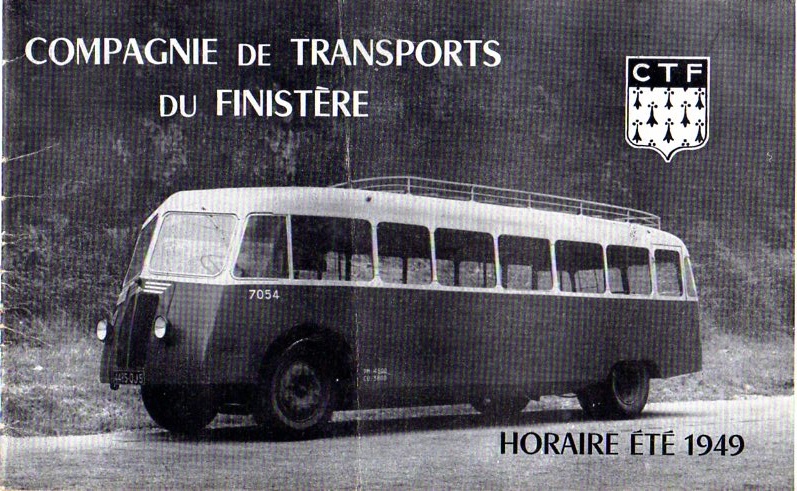
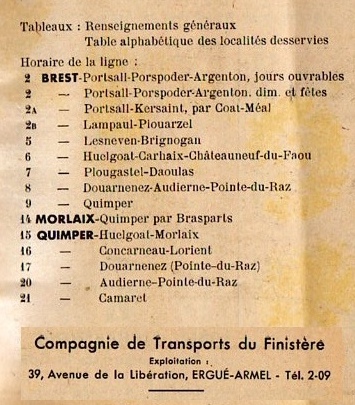
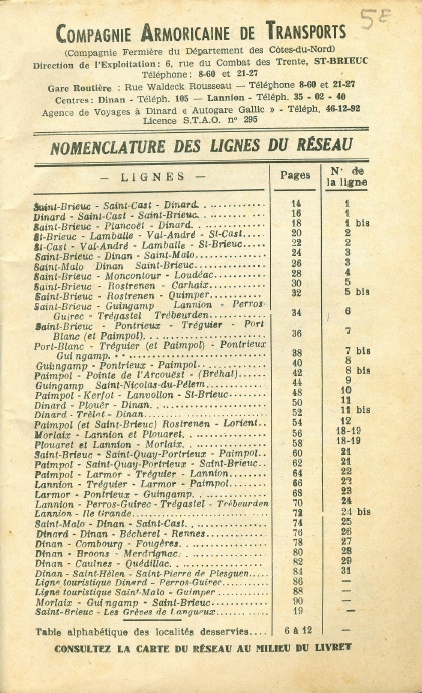
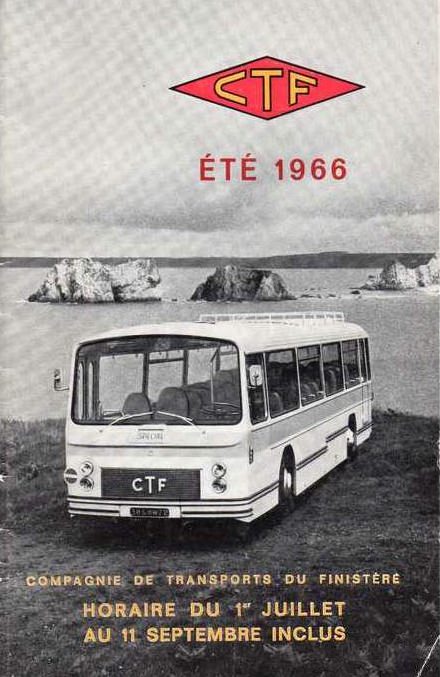
The 1949
timetable and list of routes for the Compagnie de Transports du
Finistère (compare with the map above).
Les horaires
1949 et la liste des lignes de la Compagnie de Transports du Finistère
(comparer avec ci-dessus). |
|
 |
|
 |
|
|
|
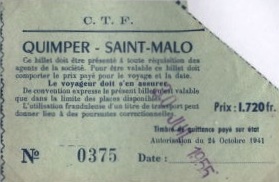
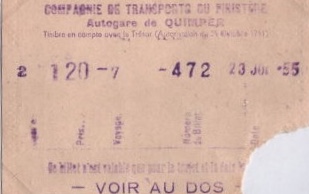
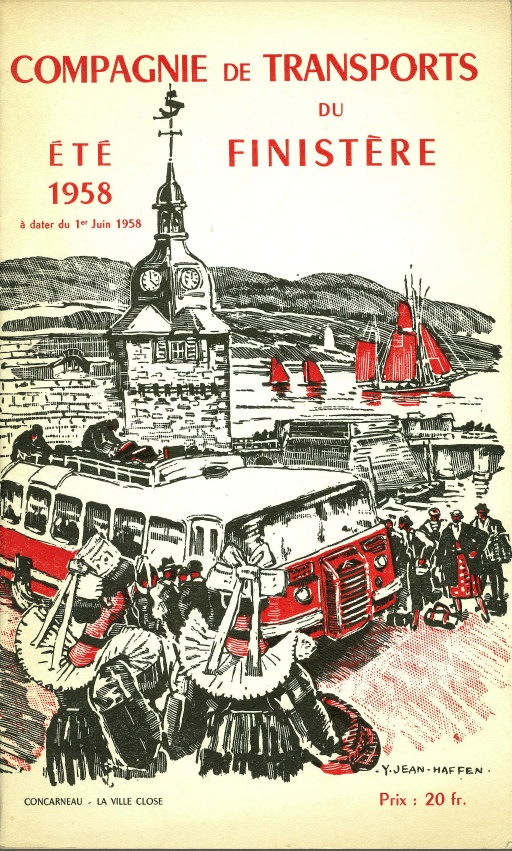
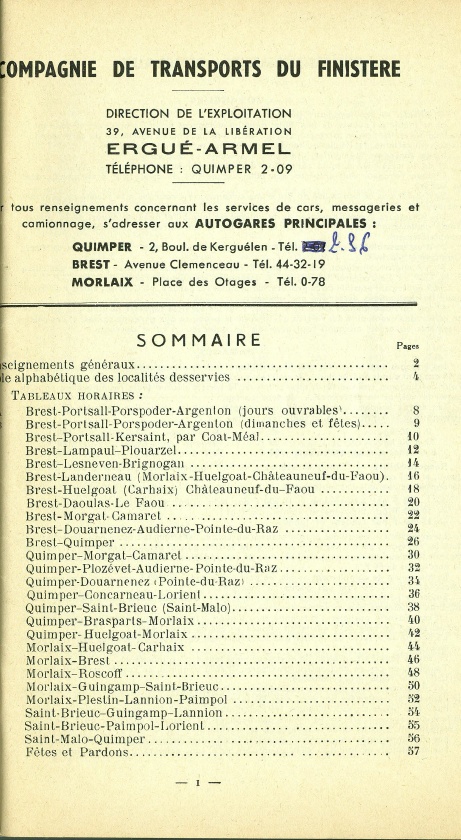
The 1958
timetable, map and list of routes for the Compagnie de Transports du
Finistère (compare with entries above).
Les horaires
1958, le plan et liste des
ligne de la Compagnie de Transports du Finistère (comparer avec
ci-dessus).
|
 |
|
 |
|
|
|
|
|
A voir:
- L'évolution
des transports de voyageurs dans le Finistère
- Les
transports routiers dans le Morbihan entre les deux guerres
- La revue 'Charge
Utile', numéros 82 et 83, avec l'histoire des TIV Transports d'Ille
et Vilaine
|
|
with thanks and
acknowledgement to the researches and collections of
John Carman,
Malcolm Chase, Richard Jacquemin, James
Bunting and PA Menant
avec des remerciements et
la reconnaissance aux recherches et collections de
John Carman, Malcolm
Chase, Richard Jacquemin, James
Bunting et PA Menant
I would be very pleased to learn more about these operators if
any French readers of
this page have further information !
Si les lecteurs
français de
cette page pouvaient m’apporter des informations
complémentaires à propos de ces autocaristes, je
leur en
serais reconnaissant !
|
|
The story of the VERNEY group and its subsidiaries in later years continues here
L'histoire du groupe VERNEY et ses
filiales dans les dernières années
se poursuit ici
Information about the travel agency and
tourism activities of Verney can be found here
Des informations
sur leurs agences de voyage et les activités touristiques du Verney sont disponibles
ici |
|
|
|
|
|
|
|
|
|