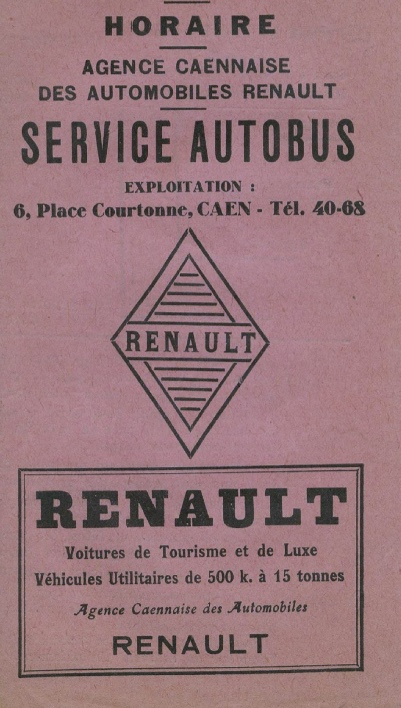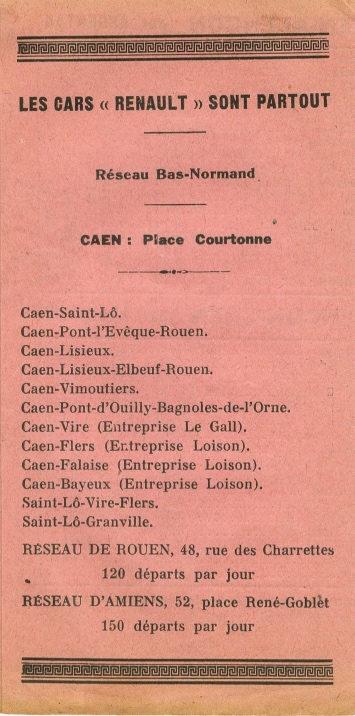
Renault, le concurrent de Citroën qui a essayé de faire la même chose mais n’est pas vraiment arrivé
During the First World War, production was focused on military needs, leaving Renault with a large production capacity after the war. In 1922 the company became Société Anonyme des Usines Renault and in 1925 the famous company logo was introduced. Renault fared well until the depression and became and remained the largest French vehicle builder with a market share of some forty per cent for commercial vehicles.
The crisis of 1929 had depressed the American car manufacturing industry and this had knock-on effects worldwide. At that time Louis Renault widened the range of activities of his company by starting the manufacture of public transport vehicles and by developing aeronautical activities through purchase of Caudron. Renault became a partner in the share capital of “Air France” and participated in the creation of “Air Bleu” for air mail transport in France.
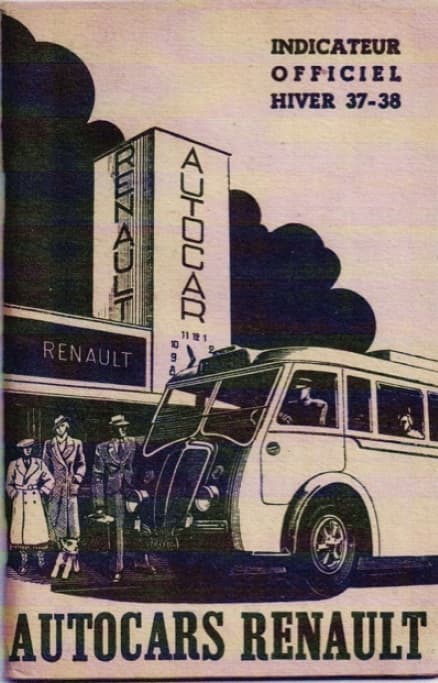
So in the early 1930s, following the lead set by their rivals Citroën, Renault started to operate buses as well as build them, with a network of routes to the outer suburbs around the capital Paris. Thus at the end of 1932 Louis Renault introduced his bus network to compete directly with Transports Citroën. Perhaps Renault was encouraged to see itself as playing the role of a competitive new entrant against the established operator Citroën, although only by a few weeks!
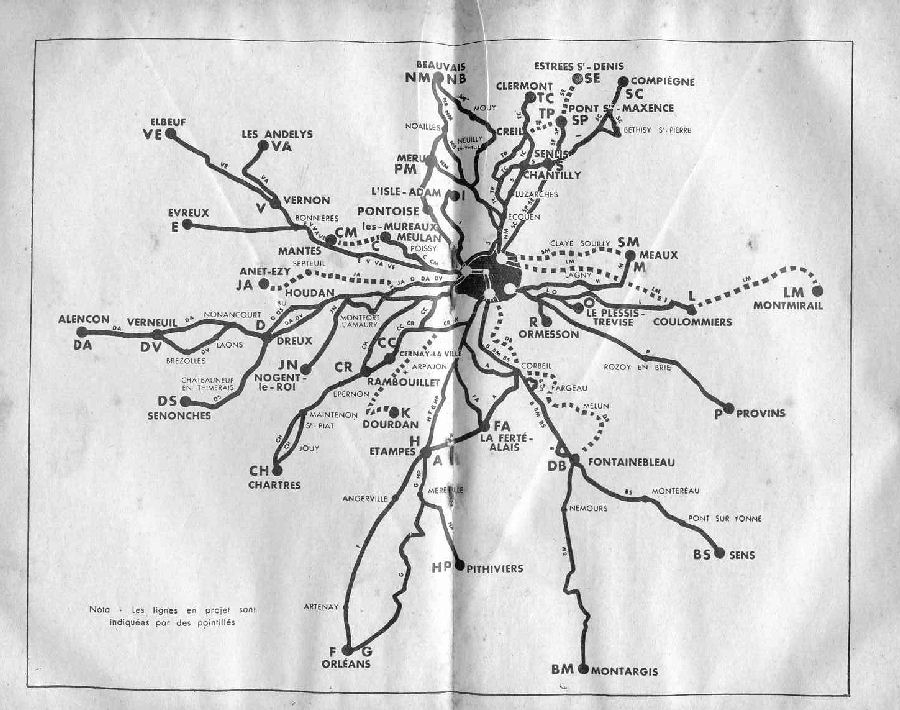
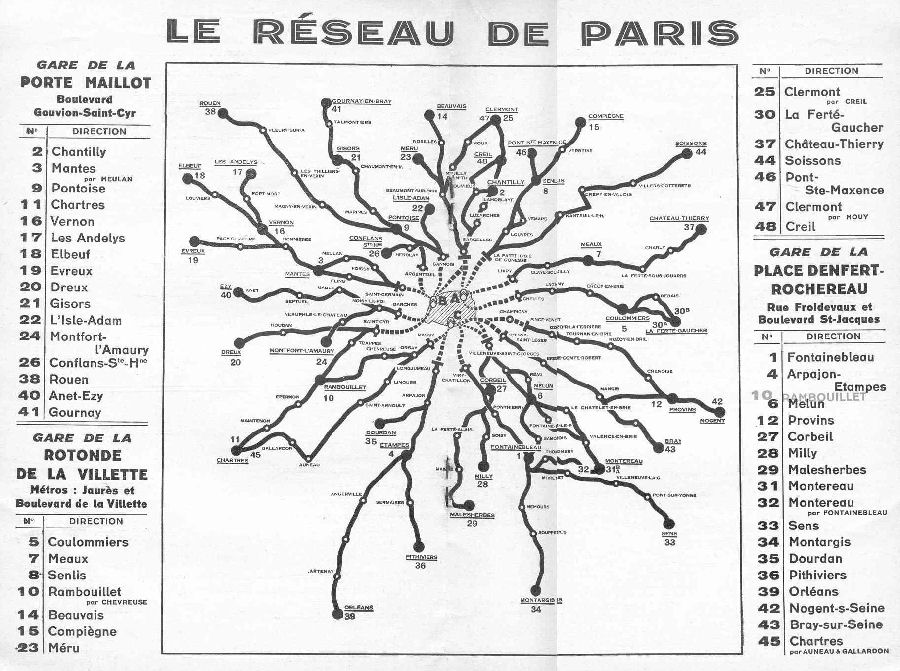
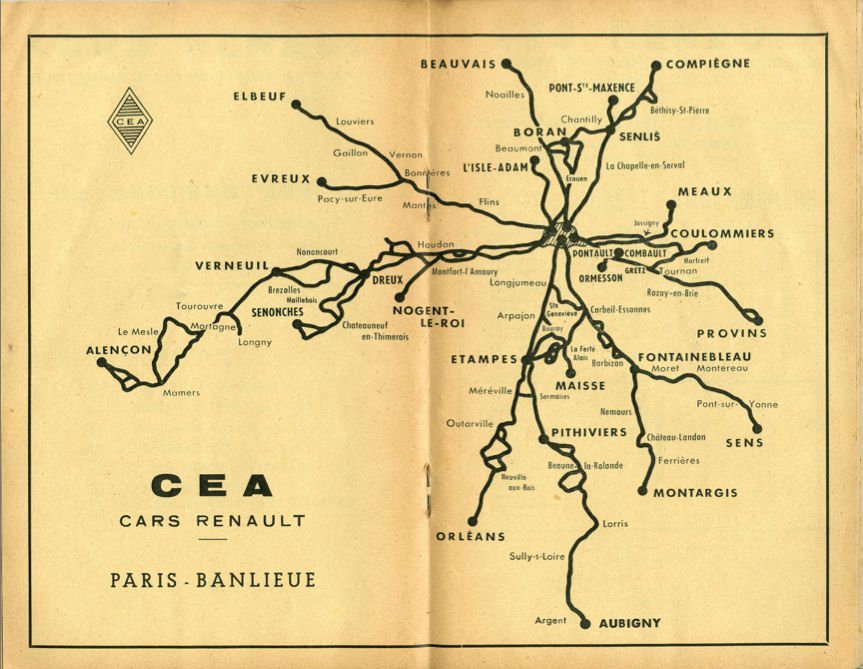
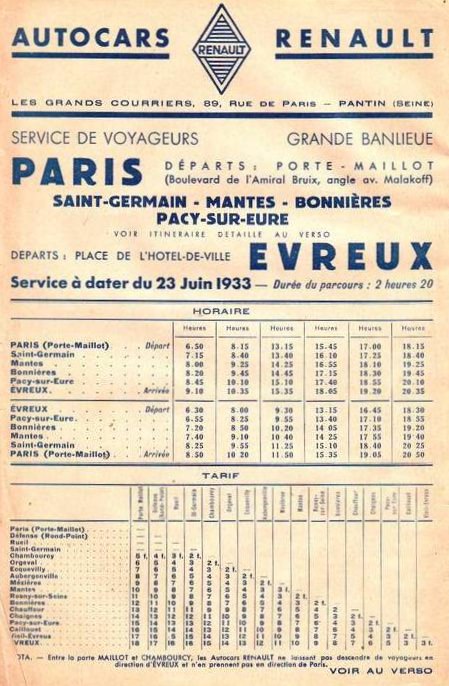
In 1933 there were thirteen routes. By 1934 Autocars Renault CEA (Compagnie d'Exploitation Automobile) had a network of thirty five suburban services radiating from Paris. Some longer routes duplicated those of Transports Citroën, eg to Mantes, Evreux, Elbeuf et Les Andelys in the west; to Fontainebleau, Montargis, Sens and Orléans in the south. Certainly they had similar departure points on the fringes of the Paris city centre - three of which were common to Citroën and Renault: Rotonde de la Villette, Porte Maillot and Place Denfert-Rochereau; whilst a fourth Porte de Vincennes was served only by the Renault services. At one time the Renault services to the west of Paris started from a basement station underneath the Galeries Lafayette department store. Unlike the rival Citroën operation, the Renault blue liveried buses with white band, typically 6-cylinder diesels with 32 seats, were to remain primarily concentrated on operating in and from the greater Paris area.
Road - rail co-ordination legislation, introduced progressively from 1934, and the nationalisation of French Railways as SNCF in 1938 served to constrain further development by the bus and coach operators. Expansion of lignes was rapid in the first few years for both the Citroen and Renault networks but officialdom was to intervene by a government decree of April 1934 for the national coordination of road and rail transport. It came to favour the latter because it excluded any change in route, with any such change being considered a new service. The new law worked well in protecting established operators, especially the railways whose routes were very unlikely to change. Thus Citroën and Renault, whilst they could not develop their networks further, did benefit from the protection of the law as already existing operators on limes already in operation. (By way of comparison regulation of bus services in the United Kingdom had occurred earlier in 1931).
By 1939 and the outbreak of the Second World War Renault was producing 30.5% of French buses, just a little ahead of their great rivals Citroën with 30.1% market share. During this period Renault's most famous bus model was the TN-series for Paris, of which 2800 were built from 1931 to 1937 (the last ones were only withdrawn from service in 1971). These distinctive dark green buses with their open rear platform would for decades be associated with Paris in the same way as red double decker buses were traditionally associated with London. Renault also produced a large range of other buses, from small vehicles to coaches, all with a front engine. From 1925 onwards Renault also built its own diesel engines, which were available on many models.
The Second World War was again a period where production was aimed at military needs with the Renault factories under German military command after the occupation of France. By the end of 1944, when the war in France was almost over, more than half of Renault's factories were destroyed. The Renault factories were nationalised and then became Régie Nationale des Usines Renault. Bus production was resumed in 1946 with most bodies built by Scemia, a company with which Renault already had a close collaboration before the war.
CEA became successor to Autocars Renault. In 1959 the Paris area timetable bore the legends of both Cars Renault and CEA. Later in 1963 CEA (not to be confused with another French transport company CGEA) went on to become CNEA (Compagnie Nouvelle d'Exploitation) and was subsequently renamed Uniroute.
The network of Renault lines in the Paris area was considerably reduced in several stages (1963, 1975, and 1982 before the restructurings of 2011 and 2015). The Renault lines around Paris were sold in 1963 to a newly affected subsidiary CEA-Uniroute with a depot 149 to 153 rue Oberkampf. And a secondary depot in Ormesson at 186 Avenue Olivier d'Ormesson (which was opened in 1958). The lines of the Porte Maillot were sold in 1963 to the SGTD. Only remained the lines of the southern network (guichet at 58 Boulevard St Jacques) and the eastern network (guichet at 104 Cours de Vincennes). In 1976 the Paris-Alencon line DA was resold to Cars Hourtoule (and renumbered 27.04) and it was soon cut back to Verneuil then Dreu, then unfortunately withdrawn in 1985.
In 1969 the CEA-Uniroute lines from Paris to the suburbs could still be clearly identified in many cases with the 1934 listing. In turn the ownership passed to the Transcet group in 1985. In 1990 Transcet, by then a subsidiary of holding company C3D, was merged with another transport company - Progecar - to form today's well known Transdev, with transport operating interests in various countries around the world.
By 1990 the operator was known as CEAT (Compagnie d'Exploitation Automobile et de Transports) and in the 21st century they operate primarily in the départements of Val-de-Marne, Essonne and Seine-et-Marne to the south-east of the Île-de-France. The Transdev-CEAT network of some 40 routes carries about 5 million passengers each year.
Pendant la Première Guerre mondiale, la production a été concentrée sur les besoins militaires, laissant Renault avec une grande capacité de production après la guerre. En 1922, la société est devenue Société Anonyme des Usines Renault et en 1925 le logo célèbre a été introduite. Renault a bien réussi jusqu'à ce que la dépression et est devenu et restait le plus grand constructeur automobile français avec une part de marché d'environ quarante pour cent pour les véhicules commerciaux.
La crise de 1929 avait fait baisser l'industrie automobile américaine de fabrication et cela avait répercussions sur le monde entier. A cette époque, Louis Renault a élargi la gamme des activités de son entreprise en commençant par la fabrication de véhicules de transport public et en développant les activités aéronautiques grâce à l'achat de Caudron. Renault est devenu un partenaire dans le capital de «Air France» et a participé en création de «Air Bleu» pour le transport de courrier par avion.
Ainsi, au début des années 1930, suivant l'exemple donné par leurs rivaux Citroën, Renault a commencé à exploiter des autobus ainsi que de les construire, avec un réseau de routes pour les banlieues autour de la capitale Paris. Ainsi, à la fin de 1932, Louis Renault a présenté son réseau de bus de rivaliser directement avec Transports Citroën. Peut-être que Renault a été encouragé à se considérer comme un nouvel entrant compétitif face à l'opérateur établi Citroën, même si ce n'est que de quelques semaines !
En 1933 il y a treize lignes. En 1934, Autocars Renault CEA (Compagnie d'Exploitation Automobile) assure un réseau de trente-cinq services suburbains rayonnant de Paris. Certaines routes dupliquaient ceux de Transports Citroën, par exemple, à Mantes, Evreux, Elbeuf et Les Andelys dans l'ouest; à Fontainebleau, Montargis, Sens et Orléans dans le sud. Certes, ils avaient des points de départ similaires à la périphérie du centre-ville de Paris - dont trois étaient communs aux Citroën et Renault: Rotonde de la Villette, Porte Maillot et la Place Denfert-Rochereau, tandis la quatrième Porte de Vincennes a été servi uniquement par les services de Renault. À un moment où les services de Renault à l'ouest de Paris a commencé à partir d'un poste de sous-sol sous les Galeries Lafayette. Contrairement à l'opération Citroën rival, le bus Renault bleue livrée avec une bande blanche, typiquement 6 cylindres diesel avec 32 sièges, ont été de rester avant tout concentrés sur exploitation dans la grande région parisienne.
La législation sur la coordination des routes et des voies ferrées, introduite progressivement à partir de 1934, et la nationalisation des chemins de fer français en tant que SNCF en 1938, ont servi à contraindre les exploitants de bus et cars à poursuivre leur développement. L'expansion des lignes fut rapide dans les premières années, tant pour les réseaux Citroën que Renault, mais les autorités intervinrent par un décret gouvernemental d'avril 1934 pour la coordination nationale des transports routiers et ferroviaires. Elles favorisèrent ces derniers car elles excluaient tout changement d'itinéraire, tout changement de ce type étant considéré comme un nouveau service. La nouvelle loi fonctionna bien en protégeant les exploitants établis, en particulier les chemins de fer dont les itinéraires étaient très peu susceptibles de changer. Ainsi, Citroën et Renault, bien qu'ils ne puissent pas développer davantage leurs réseaux, bénéficièrent de la protection de la loi en tant qu'opérateurs déjà existants sur les lignes déjà en exploitation. (À titre de comparaison, la réglementation des services de bus au Royaume-Uni avait déjà eu lieu plus tôt en 1931).
En 1939 et le déclenchement de la seconde guerre mondiale, Renault a produit 30,5% des bus français, juste un peu d'avance sur leurs grands rivaux Citroën avec une part de marché de 30,1%. Durant cette période, le modèle de bus Renault le plus célèbre était le TN-série pour Paris, dont 2800 ont été construits de 1931 à 1937 (les derniers étaient seulement retirés du service en 1971). Ces distinctifs bus verts foncés avec leur plateforme arrière ouverte depuis des décennies serait associé à Paris dans la même manière que les bus rouges à deux étages ont été traditionnellement associée à Londres. Renault a également produit une large gamme de d'autres bus et de véhicules plus petits, le tout avec un moteur avant. Dès 1925, Renault a construit ses moteurs diesel propres, qui sont disponibles sur de nombreux modèles.
La seconde guerre mondiale a été de nouveau une période où la production était destinée à des besoins militaires avec les usines Renault, sous le commandement militaire allemand après l'occupation de la France. À la fin de 1944, lorsque la guerre en France était presque terminée, plus de la moitié des usines Renault ont été détruits. Les usines Renault ont été nationalisées puis devient Régie Nationale des Usines Renault. La production d'autobus a été repris en 1946 avec la plupart des corps construit par Scemia, une société avec laquelle Renault avait déjà une collaboration étroite avant la guerre.
Le CEA est devenu successeur de Autocars Renault. En 1959, les horaires de région parisienne portaient deux noms, Cars Renault et le CEA. Plus tard, en 1963, le CEA (à ne pas confondre avec une autre société française de transports CGEA) a continué pour devenir CNEA (Compagnie Nouvelle d'Exploitation) et a ensuite été rebaptisé Uniroute.
Le réseau des lignes Renault des environs de Paris est considérablement réduit en plusieurs étapes (1963, 1975, et 1982 avant les restructurations de 2011 et 2015). Ces lignes Renault ont donc été vendues en 1963 à une nouvelle filiale renommée CEA-Uniroute (Compagnie d'Exploitation Automobiles) avec un depot 149 à 153 rue Oberkampf. Et un depot secondaire à Ormesson au 186 avenue Olivier d'Ormesson (qui avait été ouvert en 1958). Les lignes de la Porte Maillot ont été donc vendues en 1963 à la SGTD. Ne reste plus que les lignes du réseau sud (guichet au 58 Bd St Jacques) et reseau est (guichet au 104 Cours de Vincennes). En 1976 la ligne DA Paris-Alencon est revendue aux Cars Hourtoule (renumerotee 27.04) et elle sera rapidement limitee à Verneuil puis Dreux. Et malheureusement supprimee en 1985.
En 1969, les lignes du CEA-Uniroute de Paris à la banlieue pouvaient encore être clairement identifiée dans de nombreux cas avec la liste 1934. En retour, la propriété fut transmise au groupe Transcet en 1985. En 1990 Transcet, d'ici là, une filiale de la grande compagnie C3D, a été fusionné avec une autre société de transports - Progecar - pour former aujourd'hui le bien connu Transdev, avec les intérêts de transports dans divers pays à travers le monde.
Au moins 1990 les opérations ont été connus comme CEAT (Compagnie d'Exploitation Automobile et de Transports) et au 21e siècle opère essentiellement dans les départements de l’Essonne, du Val-de-Marne et de la Seine-et-Marne au sud-est de l'Île-de-France. Le réseau de bus Transdev CEAT se compose d'environ 40 lignes et il assure chaque année le transport de plus de 5 millions de voyageurs.

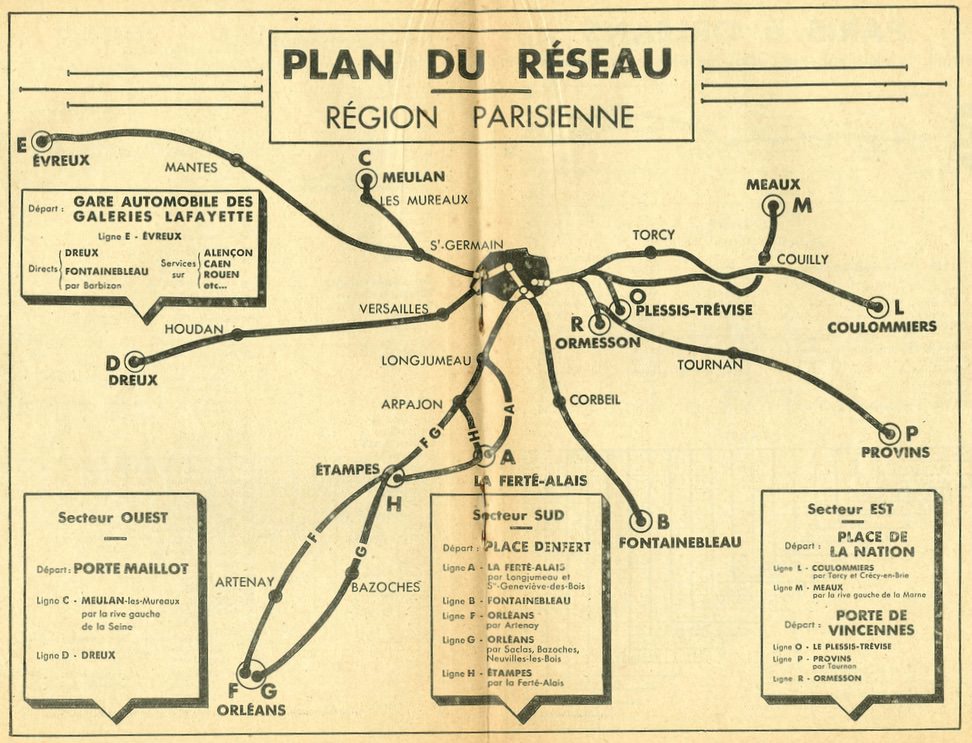
PLAN OF ROUTES FROM PARIS AREA IN 1933
The 1933 map shows thirteen routes in operation.
A year later in 1934 (map below) there were already thirty five routes.
Le plan 1933 comprend 13 lignes
Mais un an plus tard en 1934 il y avait déjà 35 lignes
|
||
Secteur Nord, terminus Rond Point de la Villette NB Beauvais NM Méru - Beauvais SC Compiègne SP Pont-Sainte-Maxence TB Creil TC Chantilly - Clermont Planned: LM Coulommiers - Montmirail Planned: SE Senlis - Estrees St-Denis Planned: SM Claye-Souilly - Meaux Planned: TP Creil - Pont-Sainte-Maxence Secteur Sud, terminus Place Denfert-Rochereau A Sainte-Geneviève-des-Bois - Etampes B Fontainebleau BM Montargis BS Sens CR Rambouillet F Toury - Orléans FA La Ferté-Alais G Saclas - Méréville - Orléans H Arpajon - Etampes HP Pithiviers Planned: DB Mélun - Fontainebleau Planned: K Dourdan Services in Secteurs Ouest, Nord and Sud (but not Est) were considerably reinforced in frequency on Sundays and Holidays. |
Secteur Est, terminus Porte de Vincennes L Coulommiers M Meaux O Le Plessis-Trévise P Provins R Ormesson Secteur Ouest, terminus Porte Maillot C Meulan - Les Mureaux CH Chartres D Dreux DS Dreux -Senonches DA Alençon DV Verneuil E Evreux I L'Isle-Adam JN Montfort-L'Amaury - Nogent-le-Roi PM Pontoise - Méru S Chantilly - Senlis V Vernon VA Vernon - Les Andelys VE Elbeuf Planned: CM Meulan - Mantes Planned: JA Septeuil - Anet-Ezy Exceptionally certain departures on routes D, DS, DA, DV and E started from Galeries Lafayette in central Paris on weekdays, before calling at Porte Maillot. |
|
UPDATE TO LIST OF ROUTES FROM WINTER 1936-1937 TIMETABLE |
||
None of the planned routes in italics in any of the four sectors above had been introduced (were they in fact ever introduced given the road-rail co-ordination policies of government at the time)? In Secteur Nord route B to Beaumont-sur-Oise had been added, also route NB barré to Beauvais via Neuilly-en-Thelle and route NC to Clermont par Mouy. In Secteur Sud, route F was suspended for the winter. Route A had been extended to La Ferté-Alais and FA was extended to Etampes. |
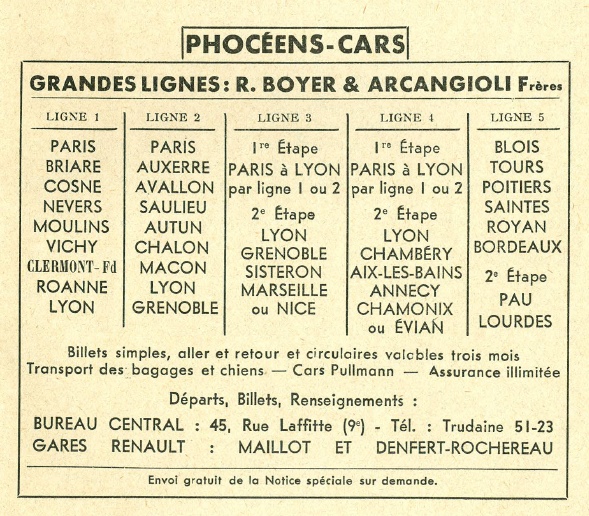
The routes in Secteur Est were unchanged. In Secteur Ouest route PM was suspended for the winter. A new route DLB ran to Dreux, L'Aigle, Argentan and Bagnoles-de-l'Orne. This timetable included reference to the long distance routes of Phocéens-Cars (see below). |
|
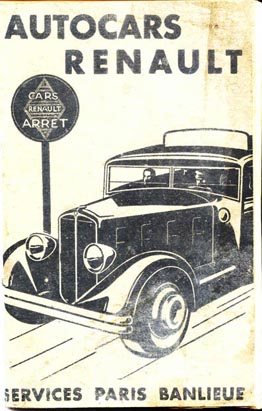 1934 timetable Horaires 1934 |
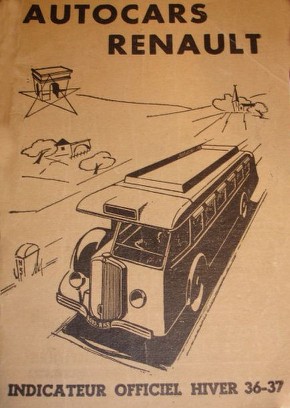 1936 timetable Horaires 1936 |
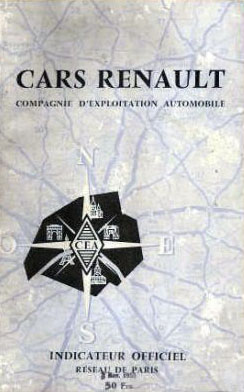 1959 timetable Horaires 1959 |
||||||
| Paris and
suburban network 1934
-
Autocars Renault CEA (compare with Transports
Citroën map below) |
||||||||
 |
||||||||
| The
rivals - the Paris and
suburban network of Transports Citroën in 1933 (many common
destinations) |
||||||||
 |
||||||||
| From the
winter 1936-1937 Autocars Renault
timetable. The long distance routes of Phocéens-Cars (Boyer and Arcangioli). It is believed there was a connection with Arcangioli Frères of Fécamp in Normandie as they had family origins from Alpes Maritimes. |
||||||||
 |
||||||||
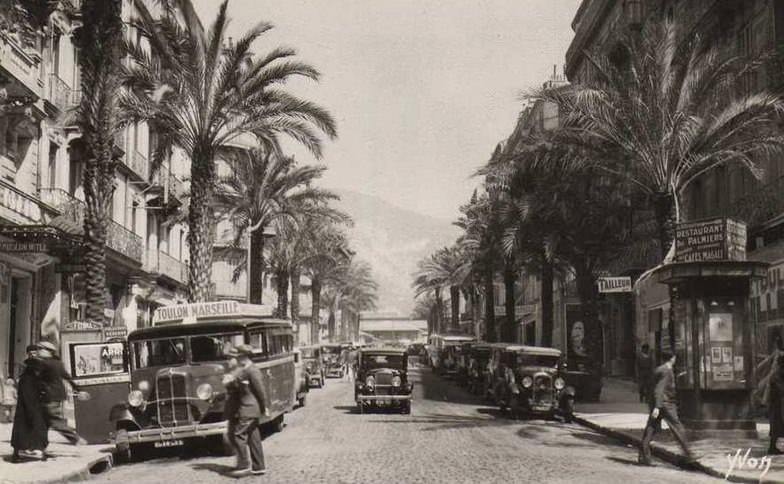
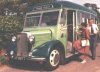
| A Renault bus in Toulon in the 1930s awaiting departure for Marseille |
||||||||
|
||||||||
|
||||||||
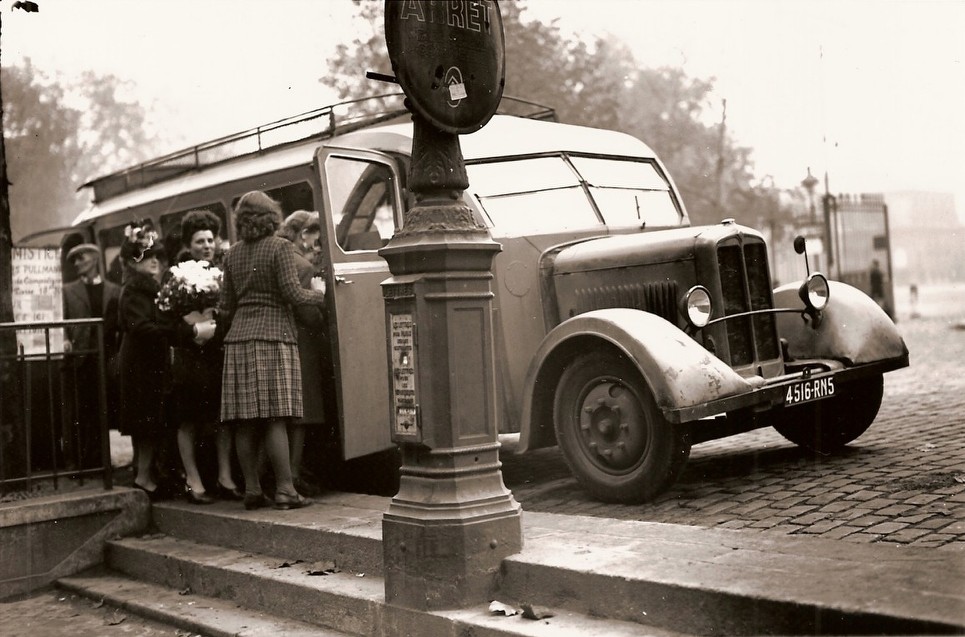
Porte
de Pantin, Paris, in the 1950s. A Renault loads prior to
departure. (Picture from TN4HBAR collection of Jean-Paul
Machuré)
|
||||||||
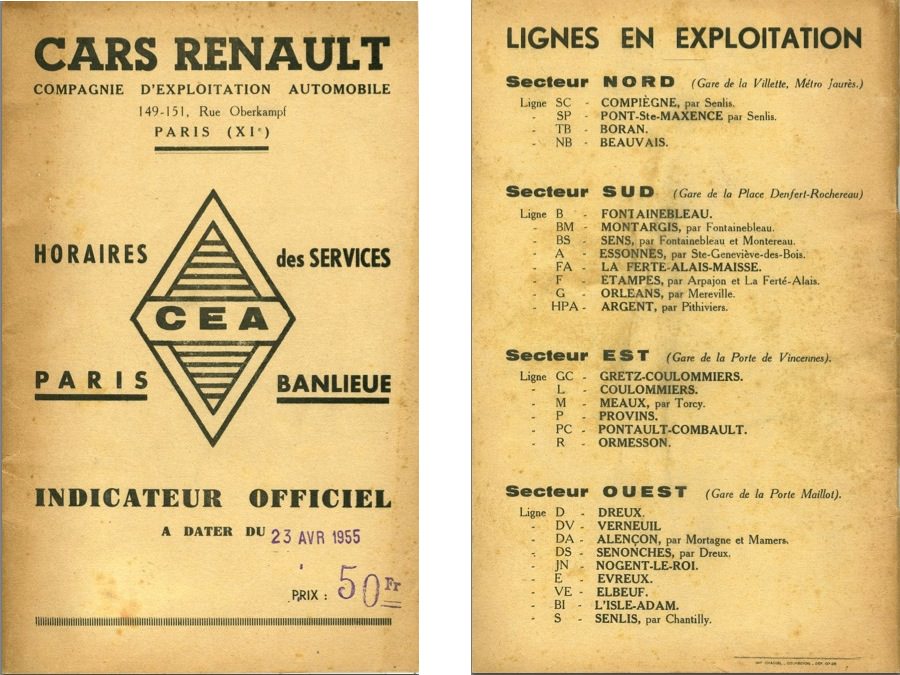
Cars Renault - CEA timetable 1955 for Paris and suburban area
showing a modest reduction of routes compared to pre-war years, In 1934 Secteur Nord had 6 routes, in 1955 4 routes remained Secteur Sud, 1934 10 routes, in 1955 8 routes Secteur Est. 1934 5 routes, in 1955 6 routes Secteur Ouest, 1934 14 routes, in 1955 9 routes |
||||||||
|
||||||||
|
||||||||
|
|||||||||||||||||||||
|
I would be pleased to learn more about this operator if any French readers of this page have further information ! Si les lecteurs français pouvaient m’apporter des informations complémentaires à propos de cet autocariste, je leur en serais reconnaissant ! With many thanks to James Bunting for the timetable scans. Avec nos remerciements à James Bunting pour les images des horaires. |
|||||||||||||||||||||
 |
Click here to return to main index page |
 |
Cliquez ici pour retourner à la page d'accueil pour la France |
||||||||||||||||||
|
|||||||||||||||||||||