
A. PEARCE & CO
The buses of Cattistock
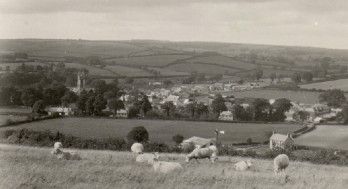
At
the start in 1919, Albert used horse
and cart and
mule-drawn van. On Wednesday and Saturday market days he
carried passengers into Dorchester whilst on
other days he delivered coal in and around the village. Trade was good so
extra help was taken on in the form of another ex-soldier George
Collins, who was subsequently to
marry Pearce's daughter Ethel. Motor vehicles were acquired
for the first time,
including the purchase new of a 14 seater Ford Model T bus in
1923. The honour of providing the first motor bus through
Cattistock fell however to Legg's of Evershot in 1920.
A new service to Yeovil via Evershot was started at this time with the motor bus, running on Fridays and alternate Mondays, but did not last for many years (until reintroduced in 1954). Horse drawn vehicles continued to play a role in the goods side of the business well into the 1930s. School transport was an important part of the business as well, and for some years there was competition for school work - even in the home village of Cattistock - from Mearns of Maiden Newton. The growing business became a partnership between Albert ('Albie') Pearce, his daughter Ethel and son-in-law George in 1925, and traded as A. Pearce & Co.
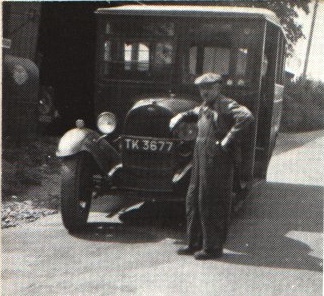
Albert Pearce outside Cattistock garage in 1948, with the firm's second bus, dating from 1929
The maroon and grey buses continued running through the second world war but by 1948 there were still only three buses in the fleet. Although Albert reached the retirement age of 65 in 1944 he continued to help run the business (and drove) until he died in May 1956, aged 77. (Susan had already passed on in February 1949, aged 73). George Collins himself died prematurely in 1948 at the age of 48, when Albert's grandson Ivor Collins took over the day to day running of the firm, but still with his mother Ethel's guiding hand. Ethel died in August 1973 at the age of 72. During the 1980s Ivor was succeeded in turn by his son Nigel - the fourth and (last) generation of the family to be involved with the business. Sadly Ivor too passed on prematurely at the age of 58 in 1985. Albert and his family lie together in the peaceful churchyard of St Peter and St Paul in Cattistock.
The main bus service was from Cattistock through Maiden Newton, Frampton, Grimstone and Stratton to Dorchester, terminating in the Council Yard off Trinity Street. This was then a wonderful place to be with a rich galaxy of independent operators vehicles gathered together from all the villages around the county town. For many years the Dorchester service was a market days only (Wednesdays and Saturdays) operation. But Pearce's did not have the road to Dorchester entirely to themselves. An Evershot operator called Frank Legg also ran via Rampisham, Cattistock and Maiden Newton on his way to Dorchester - and on the same days as well. Like Pearce, this route had started in the 1920s but in those far-off carless days there was enough trade for all - and of course buses were also very small in seating capacity compared with today. Legg also operated from Evershot to Yeovil three days a week and added a post-war route to Sherborne on Thursdays.
Other operators ran locally between Frampton and Dorchester as well - a route that changed hands several times over the years - originally started by Bertie Cox of Stratton in 1925 it passed to Mrs Platt of Frampton for a few months in December 1937 and then to Frank Whitty of Dorchester in February 1938, before passing with the sale of his business to Bere Regis and District in 1942. And lastly there was a horse drawn carrier service provided by Jack Record of Rampisham which survived into the 1940s!
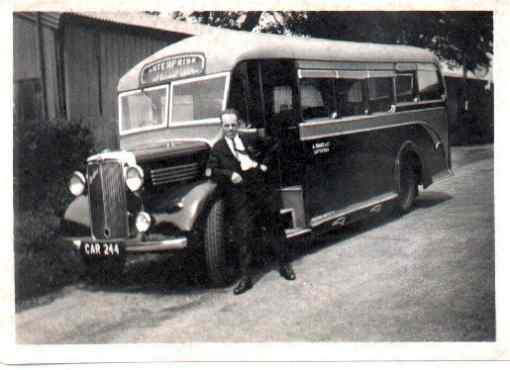
from 1947 until 1953 (photo courtesy of Paul Tompkins)
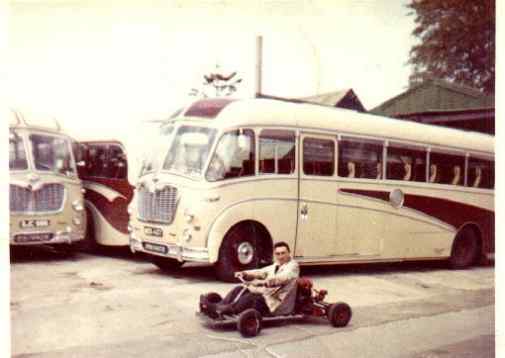
and a go-kart! (photo courtesy of Paul Tompkins)
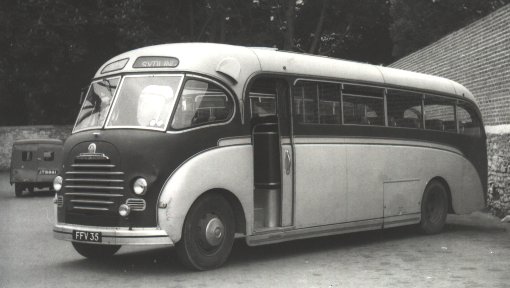
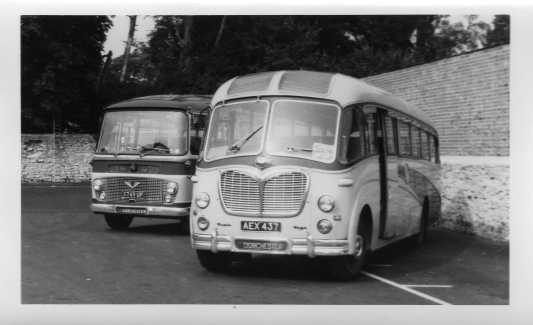
| A Pearce & Co Ltd - the fleet in summer 1967 | seats | date new | date acquired | previously with |
left
Pearce's fleet |
|
| ETK331 | Bedford SB / Duple |
C33F | 1951 | 1951 |
bought new |
1972 |
| KFX150 | Bedford SB / Duple |
C41F | 1956 | 1956 | bought new |
1975 |
| NFX433 | Austin J2 / Kenex |
11 seater |
1959 | 1959 | bought new |
1968 |
| HAW720 | Bedford SB / Duple |
C35F | 1951 | 1960 | Walden, Epping |
1973 |
| TCE557 | Austin J2 / BMC |
12 seater |
1958 | 1962 | Redford, Maiden Newton |
1970 |
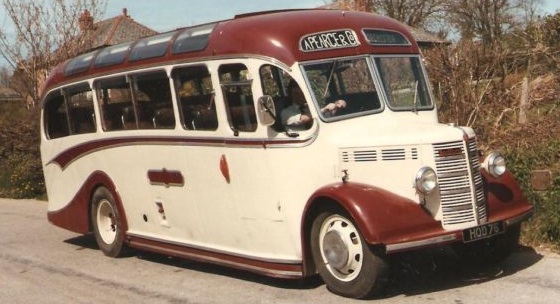
| HOD76 | Bedford OB / Duple |
C29F |
1951 | 1962 | Western National |
1978 |
| AEX437 | Bedford SB / Duple |
C41F | 1957 | 1962 | Haylett, Great Yarmouth |
1975 |
| DJC666 | Bedford SB / Duple |
C37F | 1951 | 1962 | Creams, Llandudno |
1974 |
| HDL753 | Bedford SB / Duple |
C33F | 1951 | 1963 | Shotters, Brighstone |
1974 |
| 5749UP | Bedford SB / Duple |
C41F | 1963 | 1965 | Favourite, Coundon |
1978 |
| CJT637C | Bedford SB / Duple |
C41F | 1965 | 1965 | bought new |
1978 |
| YET600 | Bedford SB / Duple | C41F | 1963 | 1967 | Jones, Market Drayton |
1978 |
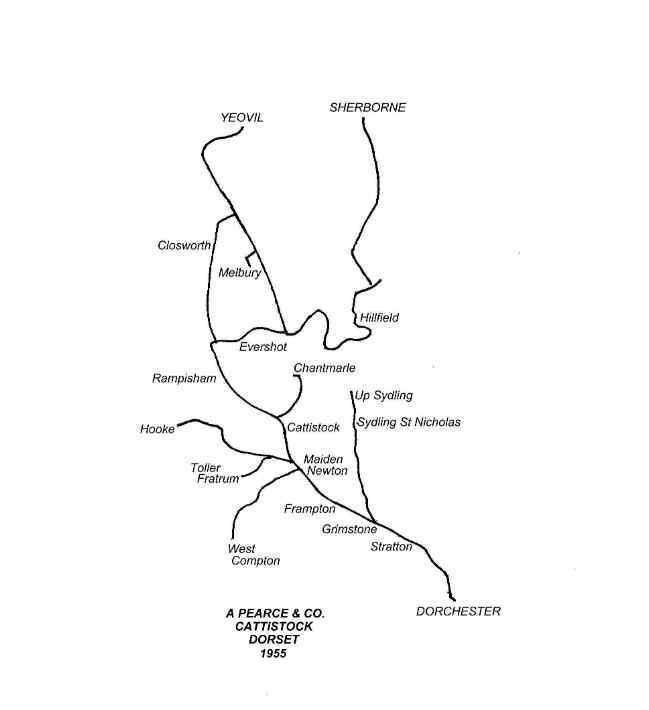
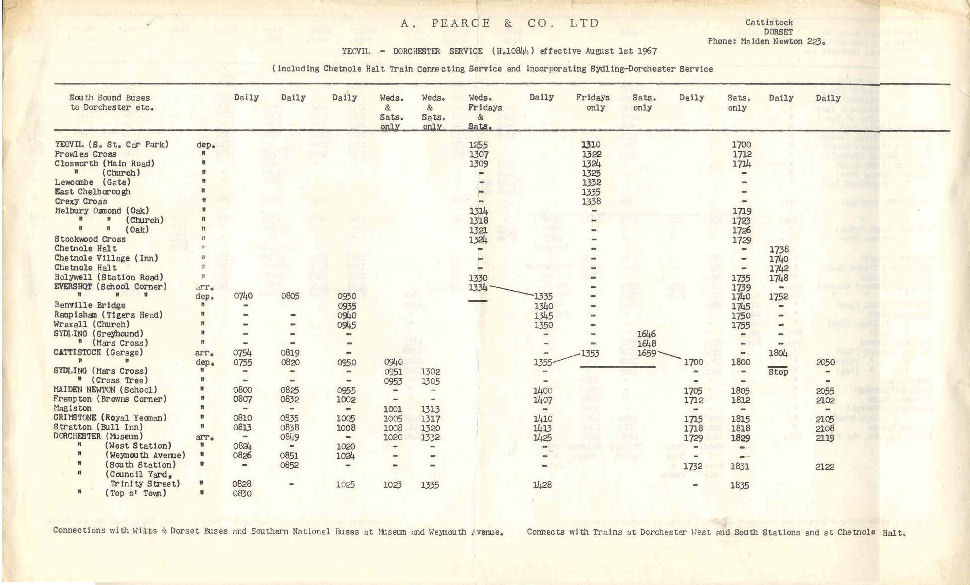
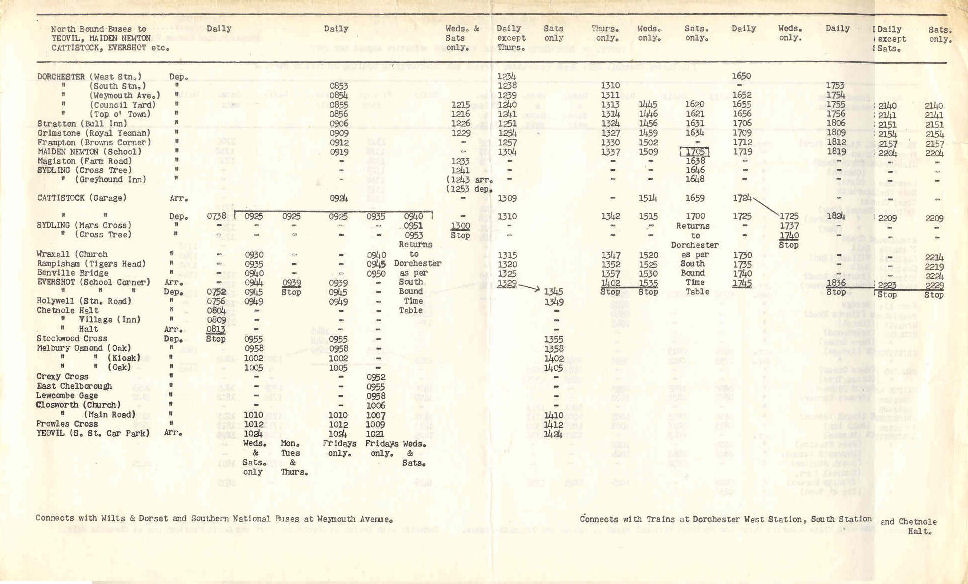
Major change was to start from 3rd October 1966 when the railway stations at Cattistock and Evershot and several other villages locally were closed to passengers. Pearce's main route from Dorchester to Yeovil was enhanced in frequency and there were now several daily journeys between Evershot and Dorchester. A new connecting facility northwards to and from the still open Chetnole Halt was provided morning and afternoon from Cattistock and Evershot for several years, to enable passengers and workers to access Yeovil on a daily basis. To avoid the need for passengers to change services in the county town a request was made in 1967 to extend the bus service from Dorchester to Weymouth, but this was refused by the Traffic Commissioner. Like many rail replacement bus services the Chetnole journeys were to have a comparatively short life and were gone by 1971. The 1967 timetable is below, at this time the Saturday late evening journeys to and from Yeovil were discontinued..
By 1972 the
fleet size had reached
eleven vehicles (including two minibuses), employed on the usual
country operator's mix of
stage carriage work, school contracts, private hire, excursions and
tours. At this time Pearce's
entered a long and
fruitful period of co-operation with Darch and Willcox, coach operators
based at Martock in Somerset, who had advertised their five coach
business for sale in 1971. The Collins family thought the
time
right for expansion and took over the Martock business, with Glen
Willcox staying on as adviser. Eventually in 1978 the
two companies combined as Pearce, Darch and Willcox Ltd, both
using
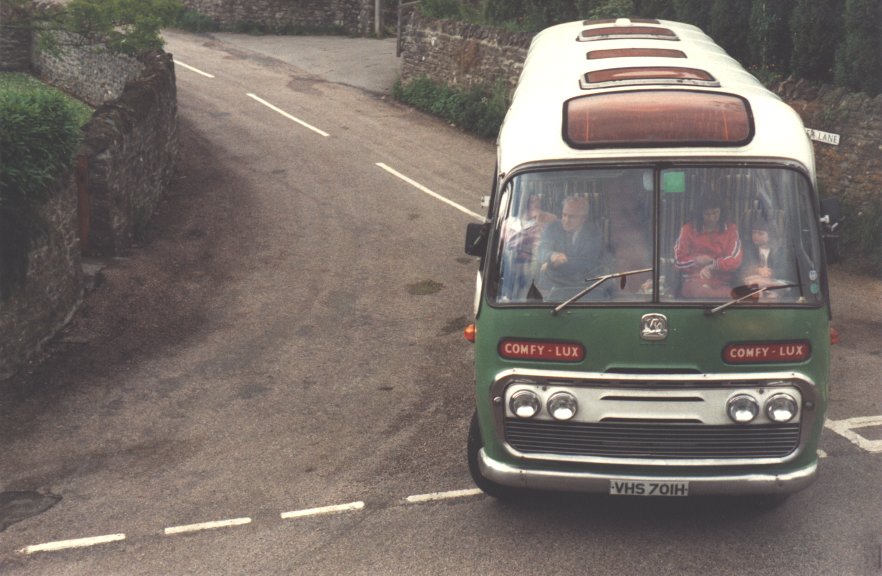
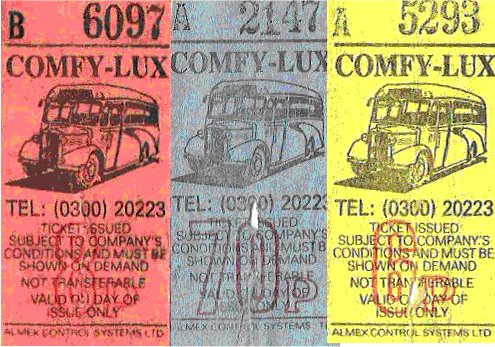
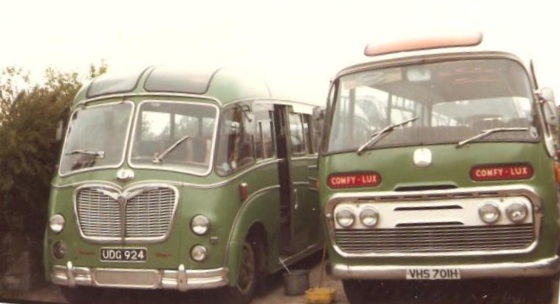
the ComfyLux trading name, but retaining their respective operating
bases at
Cattistock and Martock. By then there were twenty
seven
vehicles in the fleet. A green and white livery was adopted.
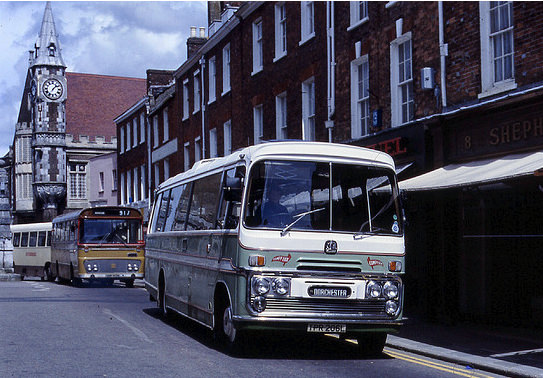
With thanks to Puckoon for the photograph.
In 1975 some journeys on the Dorchester service were diverted at Stratton to double run to serve Bradford Peverell following the withdrawal of the parallel Bere Regis & District service between Dorchester and Frampton. Charminster was also now served for the first time, a populous village near to Dorchester with several housing estates which Pearce's route had had to by-pass previously. Another event in May 1975 was the closure of the Maiden Newton to Bridport rail branch. From May Pearce operated a rail replacement bus service of a basic four return journeys a day plus market day extras. This route was to change hands several times as a consequence of the triennial county council retendering of local bus contracts.
Deregulation of buses in 1986 was to bring further major changes. Like many operators only a few journeys were registered initially to operate commercially, but the firm was successful in winning the county council tender for their main route from Dorchester through Maiden Newton and Cattistock to Yeovil. At this time the tender for the route between Dorchester and Sherborne via Cerne Abbas (operated for many years by Bere Regis & District) passed at deregulation to a very unlikely named bus operator called Air Camelot, based in Wincanton. And yes - they were in the airline business too)! Because of unreliable operation the contract was withdrawn from Air Camelot by the county council and passed for a while to Pearces in 1988, who for the second time were running buses outside of their traditional patch.
In November 1989 the Cerne Abbas route passed from Pearce's to Southern National as their route 216. At the same time an even greater calamity befell Pearce's as they also lost the contract for their traditional Cattistock route to Southern National, which became SN route 212. This was a major blow and ultimately led to the close down of the operation at Cattistock, with coach operations now primarily based in Martock. The following year 1990 the firm lost its school contracts after a rebidding exercise which was a significant loss of income. This prompted Nigel Collins to sell Pearce, Darch and Willcox to the Cawlett group, the parent company of Southern National.
The contracts for the 212 and 216 were retendered by the Dorset County Council in 1992, and they passed from Southern National to Oakfield Travel. In turn Oakfield lost the contract for these routes because of unreliable operation (it was very difficult to control and supervise buses running 40 miles away from a base in Blandford on the other side of the county), and the routes passed back to Southern National, by then associated with Pearce Darch and Willcox as fellow members of the Cawlett group. The direct connection with the founding family was lost when Nigel Collins (Albert Pearce's great grandson) left the company in September 1994 to pursue other interests, and operations from Cattistock ceased.
Evershot on its way north towards Yeovil in 1986
(photo courtesy of Joanne Paul, Los Angeles, California)
 |
 |
|
|
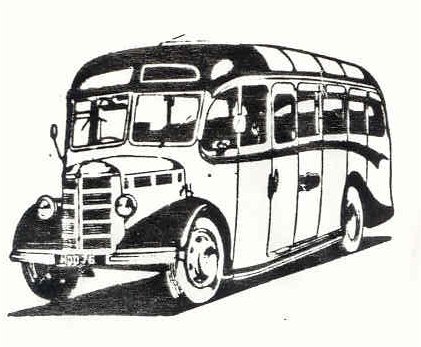
Incidentally, the picture used on the Countrybus index page is Pearce's Bedford WTB JT8077 on a private hire at Milton Abbas in the mid-1980s. For a few years at this time the WTB (once owned by singer Adge Cutler) was used by Pearce on summer routes in the Weymouth area in 1987/88, whilst HOD76 a Bedford OB operated a seven day Vintage Coach Tour to Torquay. |
||
The ex-Legg Thursday service to Sherborne which passed to Pearce in 1954 and continued weekly for many years afterwards through a succession of different operators after Pearce themselves had withdrawn from bus operation finally expired on 16th October 2003. For some time there had been only two regular passengers, a lady from Batcombe and a lady from Leigh. Wonder how they will get to the shops now? In 2004 Rampisham lost all its buses and Sydling St Nicholas had only one bus on a Wednesday service to Dorchester and Weymouth that came through from Broadwindsor on First route 213.
And further changes came. From Monday 5 September 2005 Sureline
of Portland took over the operation of both services 212 Dorchester -
Maiden
Newton - Cattistock - Yeovil and 216 Dorchester - Cerne Abbas -
Sherborne - Yeovil from First. The timetables were put on a basic two
hour frequency on each route with the two
routes linked operationally at Yeovil to operate as a circular,
although that was not advertised. Easter 2007 saw more
changes with Sureline still operating commercially on the 212 through
Cattistock from Monday to Friday, but Saturday operation of
the 212,
together with the Cerne Abbas 216 route and the Damory 307 route
through
the Piddle Valley was largely replaced by Door-to-Dorset
flexible
demand responsive services, as had already happened on the Maiden
Newton - Bridport service (as well as north of Wimborne on the
ex-Stanbridge routes, also east of Dorchester on the route to Wool,
Bovington and Lulworth). Sureline were taken over by South West
Coaches in October 2009.
Then yet more change came in
April 2011 with the D11 part of
the service
from Dorchester through Maiden Newton to Yeovil becoming the Damory
Coaches 212 (South West Coaches still retaining the bulk of the
daily
timings). The D12 route from Dorchester through Cerne Abbas and
Sherborne to Yeovil became once again the 216 but operated
by First Hampshire and Dorset. Similar change in the Piddle
Valley with the D13 reverting to Damory Coaches 307. (All these as
normal fully timetabled services. These
changes came about following the difficulties experienced
by previous operator Nordcat. These changes - with similar alterations
in the
Wimborne, Cranborne, Blandford, Piddle Valley and Bovington areas too -
saw the virtual demise of Door to Dorset: farewell
to pre-booking - something that will surely not be missed).
South West Coaches withdrew from route 212 and despite cut backs in local authority funding the Cattistock route is still run by Damory (autumn 2016) four or five times a day Monday to Friday between Dorchester and Evershot / Holywell with one morning journey continuing to and from Yeovil. Similarly the Cerne Abbas route is continued by Damory as the X11 six times a day Monday to Friday from Dorchester through Cerne and Sherborne to Yeovil, with four journeys on Saturday between Dorchester and Sherborne only.
Sad to report but from 24th July 2017 the ex-Pearce route 212 from Dorchester through Cattistock and Maiden Newton was totally withdrawn when county council financial support ceased. There are no longer buses to any of the villages once served by Pearce. Sic transit gloria mundi.
On
the X11 route from Dorchester through Cerne Abbas to Sherborne and
Yeovil the operator is now South West Coaches as successor to Damory.
| DORSET
(RURAL) |
DORSET (URBAN) |
SOMERSET |
WILTSHIRE |
HAMPSHIRE |
| FAROE ISLANDS |
NORMANDIE |
ISLE OF SKYE | LINKS |
LINCOLNSHIRE |
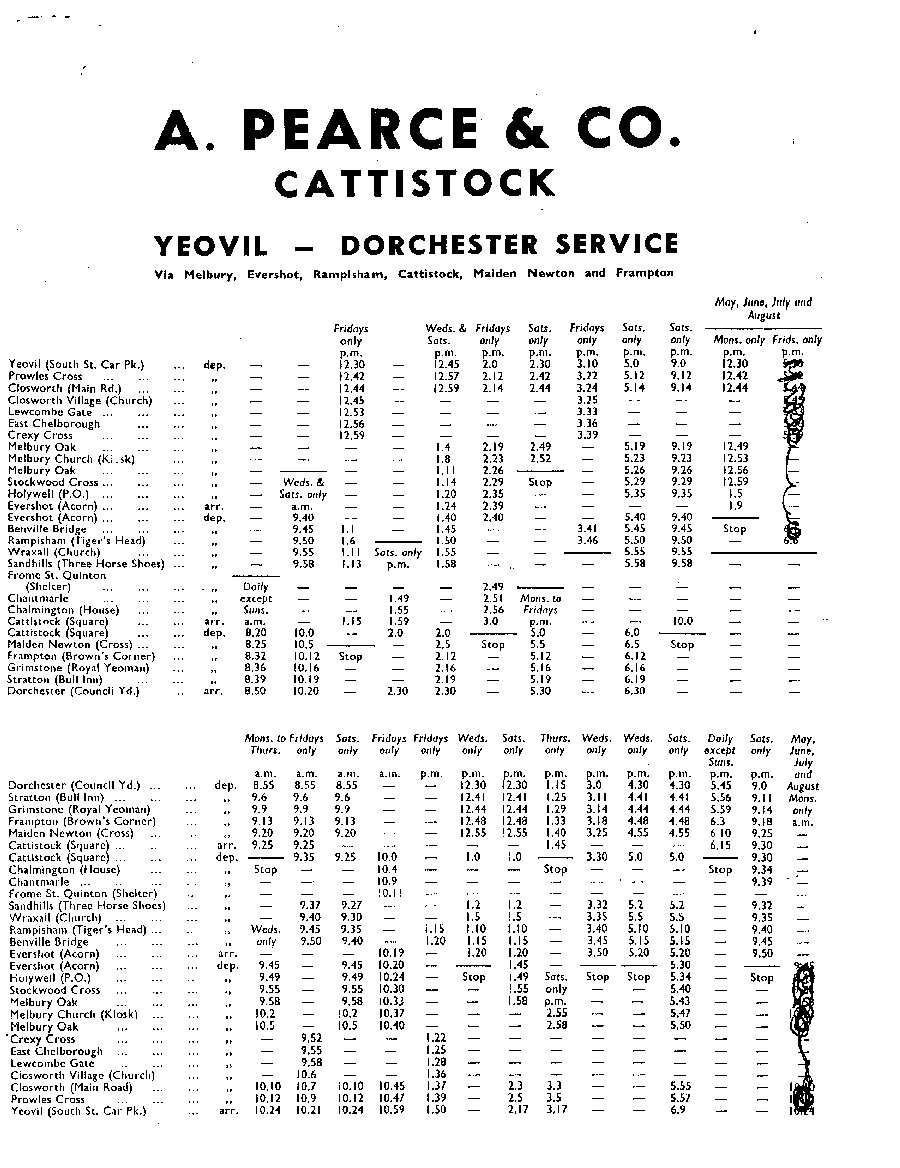
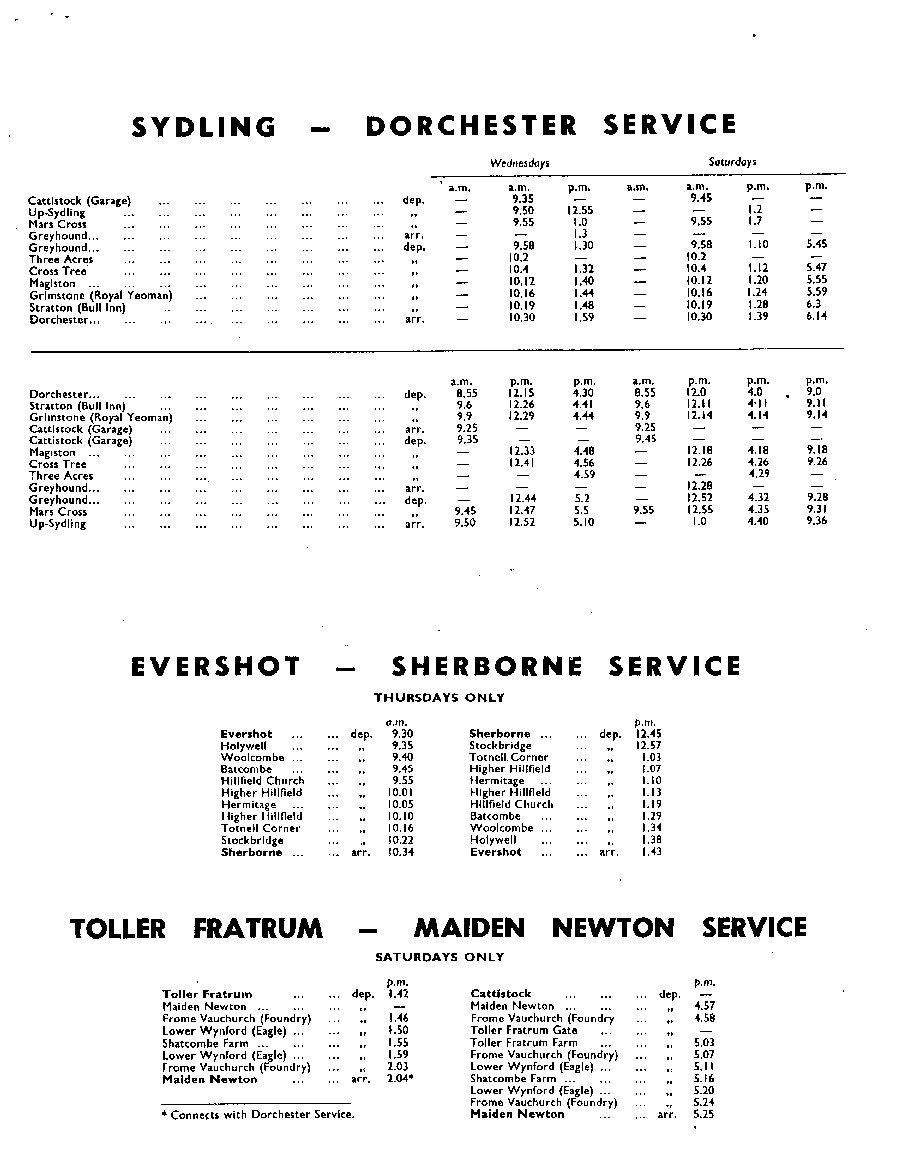
This is Pearce's 1958 bus service timetable, including the ex-Legg and ex-Crabb routes
This is Pearce's 1967 bus service timetable, after the closure of the local rail stations
| DORSET
(RURAL) |
DORSET (URBAN) |
SOMERSET |
WILTSHIRE |
HAMPSHIRE |
| FAROE ISLANDS |
NORMANDIE |
ISLE OF SKYE |
LINKS |
LINCOLNSHIRE |